




70%+Queries Automated
24/7 Customer Support Coverage
200+ AI & Automation Projects
4.98 Client Satisfaction Rating

Most Organisations Are Approaching Generative AI the Wrong Way — And Paying the Price

Generative AI is not a tool to be trialled. It is infrastructure to be built. The organisations treating it as an experiment are falling behind the ones treating it as a foundation.

The most valuable enterprise knowledge lives in documents, contracts, emails, and legacy systems unstructured, siloed, and incompatible with how most GenAI systems expect to receive information. Without solving the data layer first, model performance will never reach its ceiling.
A model trained on the internet does not know the business, the industry, the regulatory context, or the internal data that makes outputs trustworthy. Precision requires domain adaptation. Precision cannot be prompted into existence.
Organisations are selecting models before defining outcomes and deploying tools before assessing readiness. The result is GenAI investment scattered across disconnected use cases with no cumulative business value and no coherent roadmap to show for it.
Proof-of-concepts are succeeding. Production deployments are not. The technical leap from a working prototype to a reliable, enterprise-scale GenAI system is where most investments stall and most vendors disappear.
In healthcare, finance, legal, and insurance, a GenAI system that halluccinates, leaks sensitive data, or produces non-compliant outputs is not just a technical failure — it is a regulatory and reputational liability. Governance cannot be retrofitted after deployment.
Solutions built disconnected from the ERP, CRM, and data infrastructure of the enterprise produce intelligence that cannot act. The gap between where insight is generated and where decisions are made is precisely where enterprise GenAI value is lost.

Enterprise Generative AI Development Services Built for Every Stage of the Journey

From the first strategic conversation to a live, production-grade GenAI system operating at enterprise scale — every phase of the development lifecycle is owned and delivered under one roof.

Generative AI Strategy & Consulting

Identifies the highest-value GenAI opportunities within the organisation, maps the data and infrastructure landscape, and produces a phased implementation roadmap with defined outcomes — before a single model is selected or a line of code is written.

  • iconEnterprise-wide GenAI readiness assessment covering data, infrastructure, and governance maturity
  • iconUse case prioritisation ranked by business impact, feasibility, and time to value
  • iconTechnology-agnostic model selection guidance aligned to specific use case requirements

Custom Generative AI Development

GenAI solutions engineered ground-up around the specific data environment, business logic, and operational context of the organisation — delivering domain accuracy and output reliability that general-purpose tools cannot match.

  • iconPurpose-built GenAI applications for document intelligence, knowledge management, and decision support
  • iconMulti-modal capability across text, structured data, documents, and voice
  • iconModular architectures designed to expand across business functions without full redevelopment

LLM Application Development

Production-grade enterprise applications built on leading large language models from AI copilots and knowledge assistants to automated reasoning systems and intelligent document workflows.

  • iconLLM selection and configuration based on accuracy requirements, latency targets, and data privacy constraints
  • iconStructured prompt engineering, context management, and chain-of-thought reasoning frameworks
  • iconOutput evaluation pipelines ensuring consistency, factual grounding, and alignment to business requirements

LLM Fine-Tuning & Domain Adaptation

Foundation models adapted to the specific terminology, regulatory language, and business context of the organisation closing the gap between general-purpose capability and the domain precision enterprise environments demand.

  • iconSupervised fine-tuning on proprietary datasets, internal documentation, and domain-specific terminology
  • iconContinuous evaluation cycles benchmarking accuracy, hallucination rate, and contextual relevance
  • iconInference optimisation balancing output quality, response latency, and operational cost at scale

RAG Pipeline Development

Knowledge retrieval architectures that ground every GenAI output in verified internal information eliminating hallucination risk and ensuring every answer is traceable back to a source the organisation controls.

  • iconIntelligent ingestion pipelines handling PDFs, contracts, wikis, databases, and legacy repositories
  • iconHybrid retrieval combining semantic search and keyword matching for maximum accuracy
  • iconAutomated knowledge base refresh ensuring models always reason from current, accurate information

Generative AI Integration Services

GenAI capabilities connected directly to the enterprise technology stack embedding intelligence into the workflows, platforms, and data pipelines where business decisions are actually made.

  • iconPre-built and custom connectors for Salesforce, SAP, Microsoft 365, ServiceNow, and legacy infrastructure
  • iconBi-directional, real-time data synchronisation across all connected platforms and systems
  • iconSecure API architecture with role-based access controls, data masking, and complete audit trails

Enterprise Workflow Automation with GenAI

Intelligent automation of complex, judgment-intensive business processes that rules-based tools and traditional RPA cannot handle from multi-document analysis to regulatory filing and contract lifecycle management.

  • iconEnd-to-end automation pipelines from unstructured input to verified, structured output
  • iconConditional logic, exception handling, and human escalation pathways built into every workflow
  • iconCross-functional deployment across legal, finance, HR, and compliance without siloed builds

Generative AI Governance & Compliance

Enterprise-grade governance frameworks embedded into every GenAI solution — controlling outputs, protecting sensitive data, and ensuring full alignment with industry regulations from the first line of architecture.

  • iconOutput guardrails preventing hallucinations, policy violations, and non-compliant generation
  • iconCompliance-ready frameworks covering GDPR, HIPAA, SOC 2, and EU AI Act mandates
  • iconFull interaction logging, model decision traceability, and audit-ready documentation across every deployment

Deployment, Monitoring & Continuous Optimisation

Post-deployment performance monitoring, model drift detection, and structured optimisation cycles — ensuring the GenAI investment keeps compounding in value as data evolves, usage scales, and business requirements shift.

  • iconReal-time monitoring with automated alerts on output quality degradation and system anomalies
  • iconMonthly reporting on accuracy trends, usage patterns, cost efficiency, and business impact
  • iconScheduled retraining and model refresh cycles aligned to data changes and evolving requirements

The Full Spectrum of Generative AI Solutions - From Single Application to Enterprise Platform

Every organisation arrives at GenAI with a different starting point, a different data environment, and a different definition of transformation. The right solution architecture is determined by the business problem — not by what is easiest to build.

Intelligent Document Processing

Enterprises run on documents — contracts, reports, filings, invoices, medical records, policy manuals. Intelligent document processing solutions read, extract, classify, summarise, and act on unstructured content at a scale and accuracy level that manual processing cannot approach.

Intelligent Document Processing

AI Copilots & Enterprise Knowledge Assistants

Institutional knowledge is the most underleveraged asset in most organisations. AI copilots and knowledge assistants surface the right information, from the right source, at the right moment — embedded directly into the tools and workflows teams already use, without switching context or searching manually.

AI Copilots & Enterprise Knowledge Assistants

Conversational AI & Virtual Agents

Beyond the limitations of scripted chatbots lies a different class of conversational system — one that understands intent, maintains context across a dialogue, accesses live data, and takes action. These systems handle complexity that traditional support infrastructure was never designed to manage.

Conversational AI & Virtual Agents

GenAI-Powered Analytics & Business Intelligence

Data fluency should not require technical expertise. GenAI analytics solutions translate complex datasets, financial models, and operational reports into plain-language summaries, executive narratives, and actionable recommendations — making intelligence accessible at every level of the organisation.

GenAI-Powered Analytics & Business Intelligence

Content Intelligence & Automation

At enterprise scale, content is a production challenge. GenAI content systems generate, adapt, localise, and quality-check structured business content — from product documentation and marketing communications to regulatory submissions and internal knowledge bases — with brand alignment and domain accuracy built in. Built for: Marketing ·

Content Intelligence & Automation

Code Generation & Engineering Acceleration

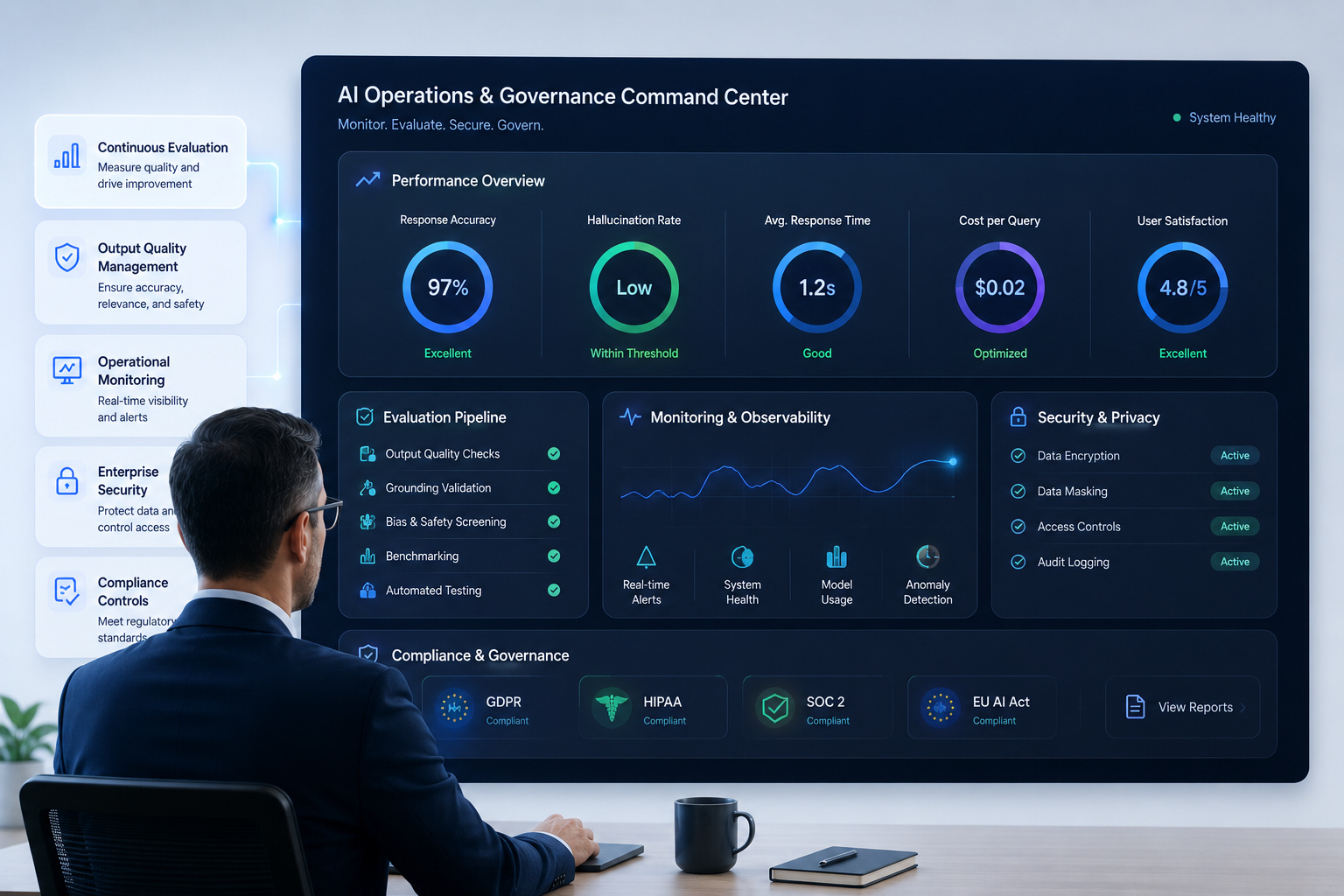
Development velocity is a competitive differentiator. LLM-powered engineering tools accelerate the full software development lifecycle — generating, reviewing, documenting, testing, and refactoring code across languages and frameworks — without compromising on quality or security standards.

Code Generation & Engineering Acceleration

Where Generative AI Creates Enterprise Value — Department by Department

The organisations extracting the most value from generative AI are not deploying it in one place. They are embedding it systematically — across every function where knowledge work, content production, and complex reasoning slow the business down.

Legal & Compliance

  • iconContract drafting, redlining, and clause-level deviation analysis across high volumes of agreements
  • iconRegulatory change monitoring with automatic filtering for jurisdiction and business relevance
  • iconDue diligence document synthesis across hundreds of filings, disclosures, and supporting materials
  • iconLitigation research summarisation condensing case law and precedent into structured reference documents
  • iconCompliance report generation with full source citation and audit-ready documentation

Finance & Accounting

  • iconBoard pack and investor report generation from live financial data with narrative commentary
  • iconNatural language querying of financial databases and data warehouses without technical intermediaries
  • iconVariance analysis narration translating numbers into plain-language explanations for non-financial stakeholders
  • iconEarnings call and analyst report summarisation for competitive intelligence and market positioning
  • iconAutomated generation of audit documentation, reconciliation narratives, and period-close commentary

Healthcare & Clinical Operations

  • iconClinical note generation and structured documentation from consultation transcripts and dictation
  • iconDischarge summary drafting with ICD coding support and clinical accuracy verification
  • iconMedical literature synthesis compressing hundreds of research papers into structured evidence summaries
  • iconPatient communication drafting in plain language from clinical records and care pathway documentation
  • iconRegulatory submission preparation including clinical trial narratives and safety report generation

Insurance

  • iconPolicy document drafting, comparison, and plain-language summary generation for customer communication
  • iconClaims narrative summarisation and adjuster report generation from structured and unstructured claim data
  • iconUnderwriting memo production drawing on risk data, actuarial models, and policy history
  • iconRegulatory filing automation across jurisdictions with compliance verification and version control
  • iconFraud detection narrative generation flagging anomalies with evidence-backed explanation for investigation teams

Marketing & Content

  • iconLong-form content production at scale with brand voice alignment and domain accuracy
  • iconCampaign brief generation from audience data, competitive intelligence, and performance history
  • iconProduct description creation and localisation across catalogues, markets, and channels simultaneously
  • iconPersonalised email and outreach copy generated from CRM behavioural data and engagement signals
  • iconVoice-of-customer synthesis from reviews, support transcripts, and survey data into strategic insight reports

HR & People Operations

  • iconJob architecture documentation including role profiles, competency frameworks, and levelling guides
  • iconInterview question sets generated from competency frameworks, role requirements, and assessment criteria
  • iconEmployee handbook and policy documentation generated, updated, and version-controlled at scale
  • iconPerformance review summarisation and structured feedback generation from manager input and objective data
  • iconLearning content development including course outlines, assessment questions, and knowledge check materials

Operations & Supply Chain

  • iconSupplier contract analysis extracting obligations, SLA terms, and risk clauses across large vendor portfolios
  • iconIncident and exception report generation from structured operational logs and sensor data
  • iconProcurement communication drafting including RFP responses, vendor evaluations, and negotiation summaries
  • iconStandard operating procedure documentation and knowledge capture from subject matter expert input
  • iconOperational performance narrative generation for leadership reporting and continuous improvement reviews

Technology & Product

  • iconTechnical documentation generation including API references, developer guides, and release notes
  • iconProduct requirement document drafting from stakeholder input, user research, and competitive analysis
  • iconCode review summarisation and refactoring recommendation generation for engineering team efficiency
  • iconCustomer onboarding content personalisation based on product usage patterns and account configuration
  • iconSupport knowledge base generation and maintenance from resolved ticket history and product documentation

The Capabilities That Determine Whether Enterprise GenAI Performs or Fails

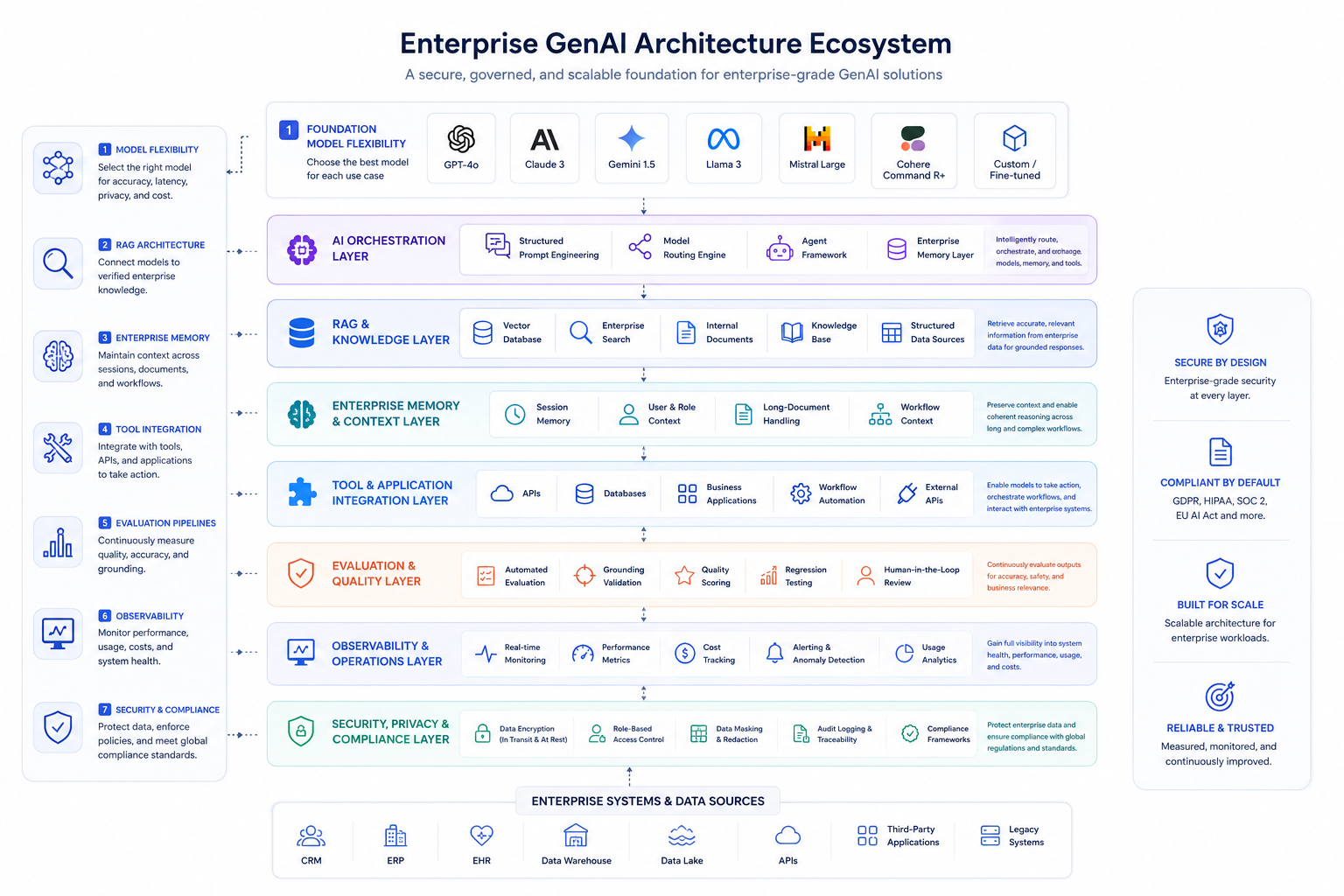
The difference between a GenAI system that works in a demo and one that operates reliably at enterprise scale is not the model. It is the architecture, the data layer, the evaluation frameworks, and the governance infrastructure built around it.

No single model is the right answer for every enterprise use case. Solutions are built on GPT-4o, Claude, Gemini, Llama, Mistral, Cohere, or custom fine-tuned models selected based on accuracy, latency, privacy, and inference cost requirements.

Retrieval-Augmented Generation connects models to verified internal knowledge sources. Hybrid retrieval combining vector search and keyword matching delivers accurate responses grounded in enterprise data.

Structured prompts, few-shot frameworks, chain-of-thought reasoning patterns, and constrained output formatting ensure consistency, reliability, and compliance-aligned outputs.

Session memory, persistent user context, and long-document processing enable coherent reasoning across extended conversations, multi-document workflows, and complex business processes.
The Capabilities That Determine Whether Enterprise GenAI Performs or Fails

Models integrate with APIs, databases, business applications, and workflow systems to retrieve information, update records, execute actions, and orchestrate multi-step processes autonomously.

Automated evaluation pipelines continuously measure factual accuracy, relevance, coherence, and output quality, enabling ongoing optimisation and performance improvement.

Distributed logging, live dashboards, cost tracking, and anomaly detection provide full visibility into model behaviour, system performance, and operational health.

End-to-end encryption, role-based access controls, inference-layer data masking, audit logging, and compliance alignment with GDPR, HIPAA, SOC 2, EU AI Act, and industry-specific regulations.

Generative AI Delivers the Most Value as Part of a Connected AI Strategy

Standalone GenAI solutions create isolated intelligence. Connected AI capability agents, automation, integration, and machine learning working in coordination creates enterprise transformation that compounds over time.

Technologies powering Gen AI development services
AI Agent Development

AI Agent Development

Autonomous AI agents that execute multi-step workflows, coordinate tools, access live data, and deliver results with minimal human oversight — the action layer that sits on top of the generative intelligence built here.
Learn More →

AI Consulting Services

AI Consulting Services

Structured discovery, use case identification, technology selection, and enterprise AI roadmap development — the strategic foundation every successful AI programme is built on, regardless of where the journey starts.
Learn More →

AI Integration Services

AI Integration Services

Connecting AI capabilities, generative and otherwise, directly to existing enterprise systems, data infrastructure, and operational workflows without disrupting current operations or requiring system replacement.
Learn More →

Machine Learning Development

Machine Learning Development

Custom ML models built for prediction, classification, anomaly detection, and decision support — the analytical layer that feeds structured insight into the generative systems operating above it.
Learn More →

AI Automation Services

AI Automation Services

Intelligent end-to-end process automation handling the complex, judgment-intensive workflows that traditional RPA tools were never designed to manage for reliability and auditability at enterprise scale.
Learn More →

The Difference Between a GenAI Vendor and a GenAI Transformation Partner

The market has no shortage of companies that can build a GenAI prototype. What is rare is a partner that takes full ownership of the outcome from the strategic clarity that precedes development to the production system that keeps performing long after launch.

Strategy Before Technology

Every engagement begins with a rigorous understanding of the business, its data landscape, its operational constraints, its regulatory environment, and its definition of success. Model selection, architecture decisions, and build priorities follow that understanding. Technology serves the strategy, not the reverse.

Full Lifecycle Ownership — No Handoffs

From the initial GenAI readiness assessment through to live deployment and continuous optimisation, every phase is executed by a single integrated team. No strategy-to-delivery handoff. No gap between what the consulting engagement recommended and what the engineering team actually built.

Regulated Industry Experience That Changes the Architecture

Building GenAI for healthcare, insurance, financial services, and legal is a fundamentally different engineering challenge than building for unregulated environments. Compliance requirements, data sensitivity, output accuracy standards, and audit obligations shape every architectural decision from day one — not as constraints applied after the fact, but as design principles embedded from the start.

Production Engineering, Not Prototype Delivery

The benchmark for every solution is not whether it impresses in a demonstration — it is whether it performs accurately, scales reliably, and operates safely under real enterprise conditions, with real data volumes, real edge cases, and real consequences for failure. Evaluation frameworks, monitoring infrastructure, and quality assurance protocols are built in from the first sprint.

Vendor Agnostic. Outcome Accountable.

No preferred model vendor. No preferred cloud platform. No preferred framework. Every technology decision is made on the basis of what delivers the best outcome for the specific use case, the specific data environment, and the specific business constraints — with full transparency about the tradeoffs of each choice.

Complete Intellectual Property Transfer

Every model, pipeline, prompt framework, architecture, and codebase built during the engagement transfers entirely to the commissioning organisation on completion. No licensing dependencies. No proprietary infrastructure that creates lock-in. No retained usage rights over anything built on the client's data.

Industries We Serve

Built for the Industries Where Conversational AI Delivers the Highest Impact

AI for Retail & eCommerce

Financial Services

Automate account queries, compliance disclosures, loan application support, and fraud alert notifications with full audit trails and regulatory alignment built in.

AI For Nonprofits

Retail & eCommerce

Automate order tracking, returns processing, product discovery, and cart abandonment recovery turning support interactions into revenue opportunities.

AI For Insurance

Manufacturing

Handle dealer support queries, supply chain status updates, maintenance requests, and internal knowledge retrieval without adding operational headcount.

AI For Financial Services

Technology & SaaS

Automate product onboarding, technical support triage, subscription management, and customer success touchpoints at the scale your growth demands.

AI for Education

Education

Handle student admissions queries, course information, fee payment support, and campus service requests delivering consistent, accurate responses across every touchpoint.

Companies We Collaborate With & Admire

As a seasoned IT company, we’re proud to collaborate with top brands that trust our expertise and innovation.

Transition Discoveries Logo
Knight Logo
VMVLA Logo
Ellie Logo
Lifebulb Logo
Practo Logo
Brex Logo
Branco Logo
Aerogreen Logo
PA Secondary Transition Logo
Optum Logo
Airlines Ambassador Logo
IMTAS Logo
Mattamy Logo
Investment Logo
CIPRIANI Logo
Signature Homes Logo
Chobani Logo
PA Department Logo
DAYCO Logo
REMAX Logo
WEBMD  Logo
FEEDING AMERICA Logo
AVISO Logo
JanBask Enterprise Client - Technology Partner 2 Logo
JanBask Enterprise Client - Technology Partner 3 Logo
Motherhood Logo
EXIDE Logo
ANAT Logo

The Engagement Process Behind Every Successful Enterprise GenAI Deployment

Every phase has a defined purpose, a defined deliverable, and a defined exit criterion. Nothing moves forward without clarity on what comes next.

AI Consulting Services
  • Discovery & GenAI Readiness Assessment
    Step 1

    Discovery & GenAI Readiness Assessment (Weeks 1–2)

    Highest-value use cases identified, data landscape evaluated, infrastructure maturity assessed, and governance requirements mapped — before a single architecture decision is made.

    Deliverable: GenAI Readiness Report + Prioritised Use Case Roadmap

  • Solution Architecture & Data Design
    Step 2

    Solution Architecture & Data Design (Weeks 2–4)

    Model selected, RAG pipeline structured, integration points defined, and compliance controls established. Data assessed, cleaned, and prepared for ingestion in parallel.

    Deliverable: Solution Architecture Blueprint + Data Readiness Assessment

  • Build & Iterate
    Step 3

    Build & Iterate (Weeks 4–9)

    Development in structured sprints — prompt engineering, model configuration, RAG pipeline build, fine-tuning, and integration completed iteratively with live demonstrations and real-time feedback at every milestone.

    Deliverable: Working Solution Builds + Sprint Demonstration Records

  • Evaluation & Quality Assurance
    Step 4

    Evaluation & Quality Assurance (Weeks 8–10)

    Output accuracy, safety, relevance, and compliance benchmarked. Adversarial testing, hallucination rate measurement, and user acceptance testing completed. Formal sign-off required before deployment proceeds.

    Deliverable: Evaluation Report + Compliance Verification + Stakeholder Sign-Off

  • Deployment & Enterprise Integration
    Step 5

    Deployment & Enterprise Integration (Weeks 10–12)

    Solution deployed into production, all enterprise integrations verified, security controls activated, and operational teams equipped to work alongside the system from day one.

    Deliverable: Live Deployed Solution + Integration Confirmation + Operational Handover

  • Discovery & GenAI Readiness Assessment
    Step 6

    Monitoring, Optimisation & Continuous Improvement

    Output quality, system performance, and model drift monitored continuously. Retraining cycles and proactive optimisation aligned to data changes and evolving business requirements.

    Deliverable: Monthly Performance Reports + Model Drift Analysis + Optimisation Roadmap

Frequently Asked Questions

Most enterprise AI tools are built to classify, predict, or detect — they analyse existing data and surface a result. Generative AI creates new outputs — documents, summaries, narratives, code, and structured content — by reasoning over learned patterns and, in production enterprise systems, retrieving internal information. The practical difference is that generative AI can produce usable, human-quality work products that previously required skilled human effort at every step.

Consumer and productivity tools are built for general use on public data. Enterprise GenAI solutions are purpose-built for specific business workflows — connected to proprietary internal data, fine-tuned on domain terminology, integrated with existing enterprise systems, governed by compliance frameworks, and evaluated against accuracy benchmarks the business defines. The gap between the two is the gap between a useful tool and reliable infrastructure.

The quality and structure of available data matters more than the volume. Most organisations already have what is needed — internal documents, contracts, policy manuals, operational records, and system data. A data readiness assessment conducted during the discovery phase provides an honest picture of what the current environment enables and what preparation, if any, is required before development begins.

Hallucination elimination is an engineering discipline, not a model setting. RAG architecture grounds every output in retrieved, verified internal sources. Domain fine-tuning reduces the model's reliance on probabilistic generation for business-specific content. Structured output constraints, automated evaluation pipelines, and continuous monitoring catch and flag accuracy degradation before it reaches end users. No responsible enterprise GenAI deployment relies on a single control.

A well-scoped, focused solution typically reaches live deployment within eight to twelve weeks. Solutions requiring extensive data preparation, custom model fine-tuning, complex RAG pipelines, or deep enterprise integration may require fourteen to eighteen weeks. A detailed, milestone-based timeline is provided and agreed upon before any development commitment is made.

Security-first principles are applied at every stage — role-based access controls, end-to-end encryption, data masking at the inference layer, complete interaction audit logging, and alignment with GDPR, HIPAA, SOC 2, EU AI Act, and any additional frameworks relevant to the specific industry and jurisdiction. Proprietary business data is never used to train public models or shared outside the boundaries of the engagement.

Compliance is an architectural requirement, not a post-deployment checklist. Governance frameworks, output guardrails, audit logging, and regulatory alignment are embedded into the solution design from the first sprint — not added after the fact. Every solution deployed in a regulated environment is built against the specific compliance obligations of that industry, with documented verification before go-live.

Full intellectual property ownership transfers entirely to the commissioning organisation upon project completion. Every model, fine-tuning dataset, RAG pipeline, prompt framework, architecture, and codebase built during the engagement belongs to the client. There is no retained licensing dependency, no proprietary infrastructure lock-in, and no ongoing usage rights retained over anything built on the client's data.

Yes. Existing GenAI solutions that hallucinate excessively, fail to scale, produce inconsistent outputs, or never reach production are regularly taken on. A comprehensive technical and output quality audit is conducted first — covering model selection, RAG architecture, data quality, evaluation frameworks, and integration design — followed by a prioritised improvement plan distinguishing what is worth preserving from what needs to be rebuilt.

The process begins with a free, no-obligation discovery call. In thirty to forty-five minutes, a clear and honest assessment of where generative AI can create measurable enterprise value — and what the path to achieving that looks like — is provided. No generic presentations. No predetermined solutions. A precise, business-focused conversation about what is genuinely possible.

Our Blogs

Deep Dive Into Insights - Blog Your Way to Brilliance!