

Industries We Serve
Built for the Industries Where Conversational AI Delivers the Highest Impact

Financial Services



Retail & eCommerce

Manufacturing

Technology & SaaS


Insurance organizations face rising claim volumes, growing fraud risk, legacy system constraints, and policyholders who expect faster, more personalized service. AI for insurance is how leading carriers and agents are closing that gap operationally and competitively.
Trusted by 500+ Businesses, Rated for Excellence!




The insurance industry sits on vast amounts of data yet most of it remains underutilized, siloed, or locked inside legacy systems. These are the eight challenges driving the strongest demand for AI in the insurance industry today.

From Claims and Underwriting to Fraud Detection — AI That Delivers Measurable Results
Automate the full claims lifecycle from first notice of loss to final settlement reducing processing time, operational costs, and policyholder wait times.
 Automated FNOL intake and document extractionStraight-through processing for standard claimsIntelligent claims routing and priority scoringReal-time settlement status updates for policyholders
Eliminate manual effort from routine, high-volume policy tasks reducing processing costs and freeing experienced staff for higher-value underwriting and relationship work.
Automated policy generation, issuance, and endorsement processingIntelligent renewal management and retention outreachCancellation and reinstatement processing without manual interventionAutomated compliance documentation across all policy transactionsExtract, classify, and process high volumes of structured and unstructured insurance documents with speed and accuracy that manual processing cannot match.
Automated data extraction from PDFs, scanned forms, and handwritten documentsIntelligent document classification and routingCross-referencing extracted data against policy terms and coverage conditionsSignificant reduction in manual data entry errors and processing backlogsReplace manual risk assessment with machine learning models that analyze broader data signals and deliver consistent, accurate decisions at scale.
Automated risk scoring across personal and commercial linesReal-time enrichment from third-party data sourcesConsistent decisions across high application volumesReduced time from submission to policy issuanceMove from reactive investigation to proactive, real-time detection flagging suspicious activity and high-risk claims before payments are authorized.
Real-time fraud scoring on every incoming claimNetwork analysis to surface organized fraud schemesBehavioral anomaly detection across claims historyLower false positive rates vs rules-based systemsStrengthens reserving accuracy, improves portfolio management decisions, and identifies emerging risk concentrations before they translate into unexpected losses.
Catastrophe modeling and natural disaster exposure forecastingPortfolio-level risk concentration analysisMore accurate loss reserve estimationEarly identification of emerging risk trends across lines of businessDeliver fast, accurate, and personalized policyholder service across every channel without expanding call center headcount or extending response times.
24/7 omnichannel support across web, mobile, and voiceNatural language understanding for complex policy queriesIntelligent escalation to human agents when requiredPersonalized coverage recommendations driven by customer dataMaintain compliance across all operating jurisdictions continuously reducing manual burden and lowering the risk of reporting errors and regulatory penalties.
Continuous monitoring of regulatory changes across jurisdictionsAutomated preparation and submission of regulatory filingsComplete audit trails across all underwriting and claims decisionsExplainable model outputs meeting regulatory transparency standardsProcess continuous behavioral data from connected vehicles, wearables, and IoT devices to support dynamic, personalized insurance products and more accurate individual risk pricing.
Real-time driver behavior analysis for personal and commercial autoDynamic premium adjustment based on verified usage dataIndividual risk profiles built from continuous behavioral data streamsEmbedded fraud detection within telematics data pipelinesThe insurance industry is accelerating AI adoption to combat fraud, improve underwriting accuracy, automate claims processing, and drive operational efficiency at scale.
AI Insurance Market — projected global AI in insurance market size by 2026 as carriers and insurtech firms increase investment.
Annual Fraud Losses — estimated yearly cost of insurance fraud in the United States driving demand for AI-powered fraud detection.

Claims Acceleration — reduction in claims processing time achieved through intelligent claims automation.
Executive Adoption — insurance leaders ranking AI as a top strategic priority over the next three years.
Underwriting Accuracy Gain — improvement reported by insurers using machine learning-driven risk models.
Fraud Detection Savings — estimated annual savings generated through AI-powered fraud detection systems.
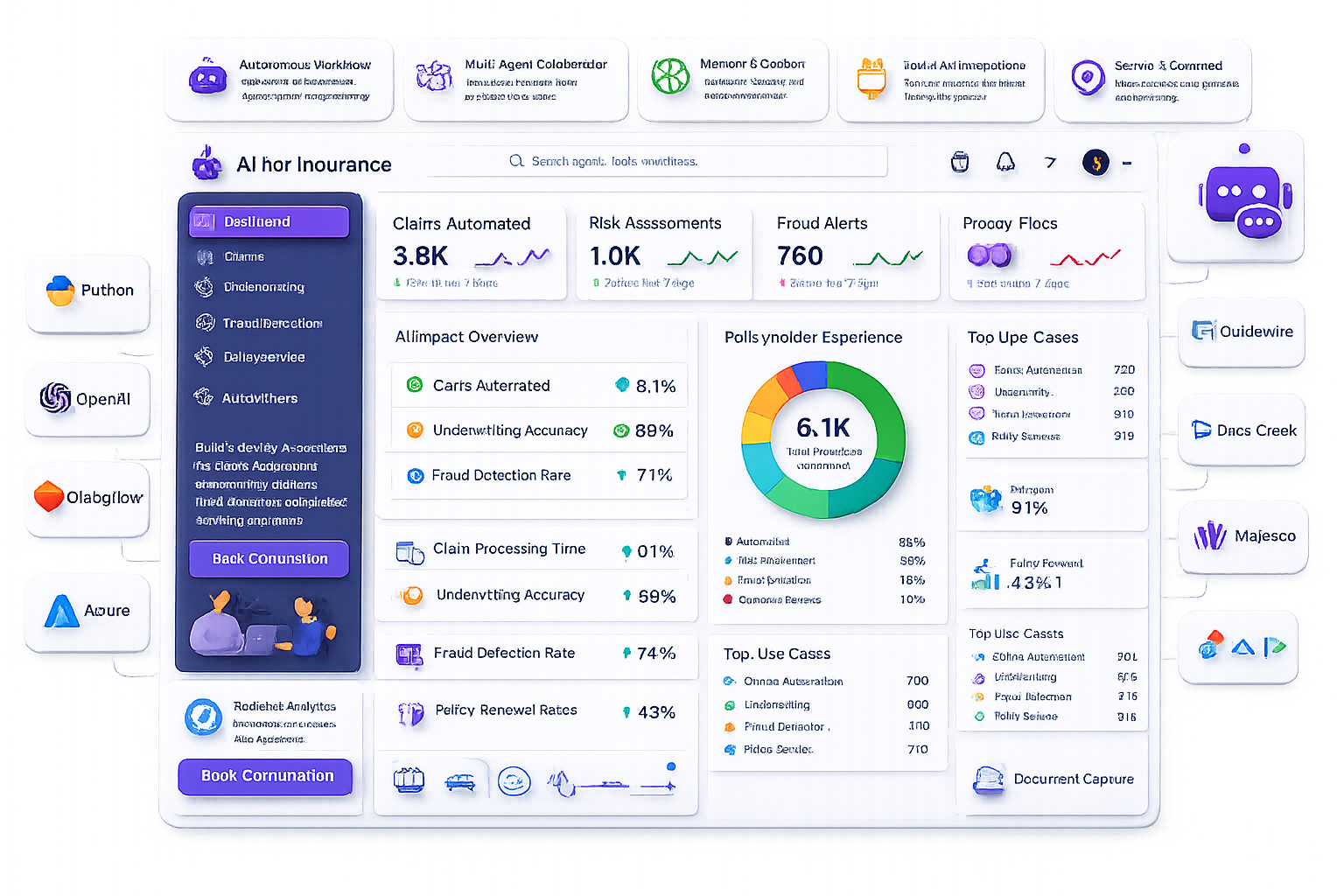






Every Tool Selected for Performance, Compliance, and Compatibility With Insurance Data Environments
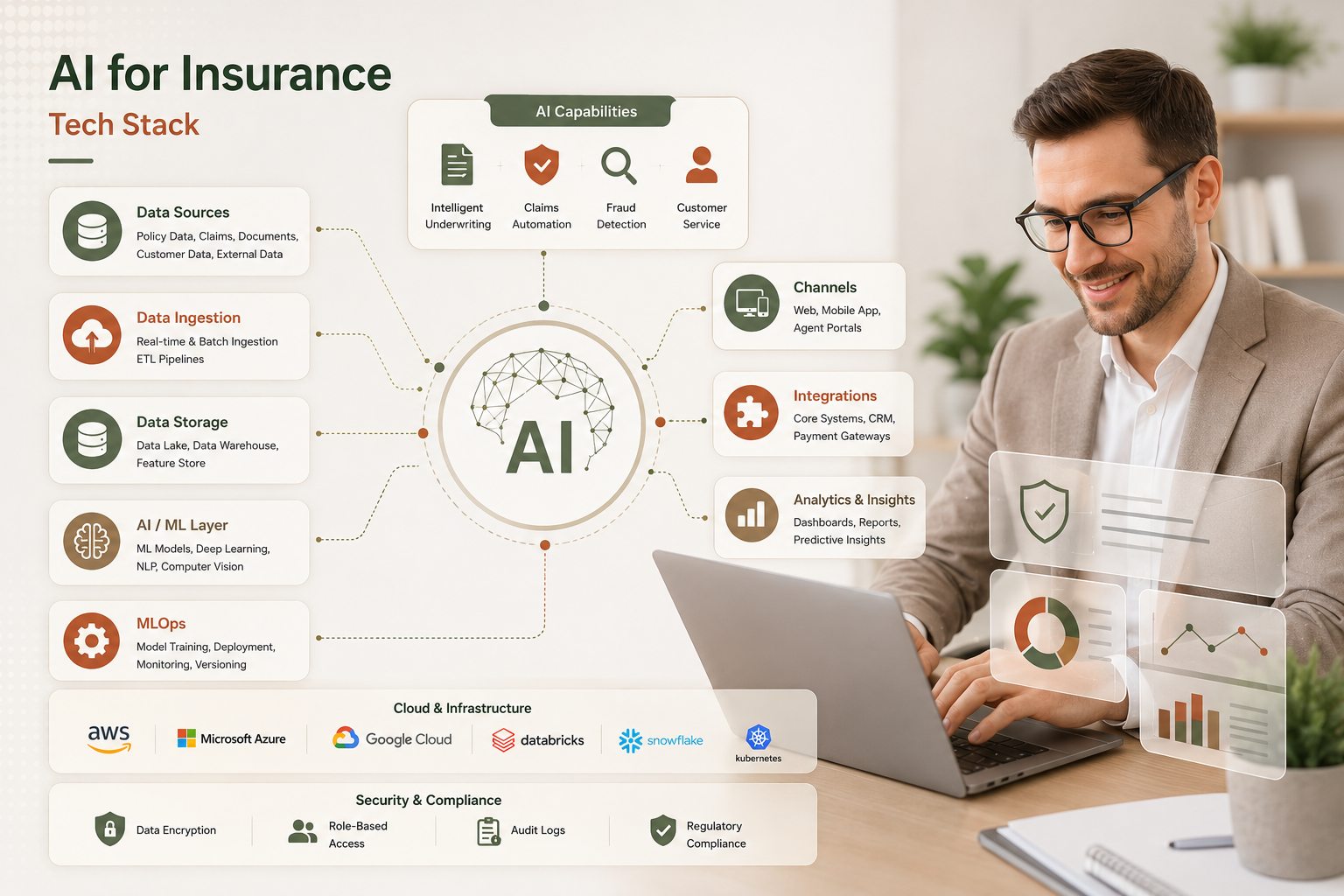

OpenAI GPT-4o • Anthropic Claude • Google Gemini • Meta Llama 3 • Mistral

Guidewire • Duck Creek • Majesco • Salesforce Financial Services Cloud • Applied Epic

AWS (Textract, SageMaker) • Microsoft Azure AI • Google Vertex AI

PyTorch • TensorFlow • LangChain • Snowflake • Databricks
Insurance AI solutions require more than technical capability. They require regulatory awareness, operational understanding, measurable outcomes, and long-term accountability.


Insurance AI that is not built with regulatory compliance from the ground up creates legal and operational risk that compounds over time. We design every solution around applicable state, federal, and international insurance regulations — not as a final review, but as a foundational requirement from day one.

The most common reason insurance AI fails is that it does not fit how insurance organizations actually operate. We build every solution around real underwriting workflows, live claims environments, and the day-to-day operational realities of carriers, brokers, and agents — so adoption is built in, not assumed.

Insurance organizations need results — not reports on how much was built or deployed. Every engagement we run is tied to defined operational, financial, and compliance outcomes that are tracked, reported, and optimized throughout the full delivery lifecycle.

Strategy, build, deployment, and ongoing optimization — we own every phase. Performance does not just matter at launch. It matters at 6 months, 12 months, and beyond. We stay accountable for results long after go-live — not just until the project is closed.
Built for the Industries Where Conversational AI Delivers the Highest Impact
As a seasoned IT company, we’re proud to collaborate with top brands that trust our expertise and innovation.
.png)
.png)
.png)
.png)
.png)


.png)
.png)
.png)
.png)
.png)





.png)










AI for insurance is the application of machine learning, natural language processing, and intelligent automation to improve underwriting, claims processing, fraud detection, customer service, and compliance operations across the insurance industry. Insurance companies, brokers, and agents use AI insurance services to reduce operational costs, improve decision accuracy, and deliver better policyholder experiences at scale.
Artificial intelligence for insurance is most widely used across six core areas:
AI in the insurance industry improves claims processing by automating the full claims lifecycle from first notice of loss through final settlement. Machine learning models extract data from claim documents and images, cross-reference policy terms, score claims for fraud risk, and route or resolve claims automatically — reducing settlement timelines by up to 60% across high claim volumes.
Yes — AI for insurance companies can be fully compliant when regulatory requirements are built into the solution architecture from day one. Every AI insurance technology deployment must include encrypted data pipelines, role-based access controls, complete audit logging, and alignment with applicable state, federal, and international data privacy requirements before going live.
AI in the insurance sector detects fraud by training machine learning models on historical claims data to identify suspicious patterns, flag anomalous behavior, and surface high-risk claims for investigation in real time — before payments are processed. This shifts fraud management from reactive case investigation to proactive, continuous screening across every incoming claim — reducing fraud losses significantly across personal and commercial lines.
AI driven insurance solutions are used to automate and optimize the most operationally complex and data-intensive workflows in insurance — including claims processing, underwriting decisions, fraud detection, policy administration, regulatory compliance reporting, customer service, and usage-based insurance programs. Insurance automation solutions built on machine learning and natural language processing deliver measurable improvements in speed, accuracy, and cost efficiency across all these areas.
Insurance industry innovation through AI refers to the adoption of machine learning, generative AI, and intelligent automation to fundamentally transform how insurance organizations operate — moving from manual, rule-based processes to adaptive, data-driven systems that continuously improve over time. Leading carriers are using AI insurance technology to create new products, personalize policyholder experiences, and build operational capabilities that were not possible with traditional technology.
Yes. AI insurance technology can integrate directly with leading core insurance platforms including Guidewire, Duck Creek, Majesco, Salesforce Financial Services Cloud, and Applied Epic — using modern API architecture and standards-based data exchange. Insurance automation solutions built on these integrations work within existing workflows without requiring system replacement or operational disruption.
The best starting point for any AI for insurance initiative is a structured discovery process that maps current workflows, identifies the highest-value use cases, and defines measurable outcomes before any technology decisions are made. Organizations exploring AI insurance services for the first time benefit most from beginning with a focused, high-impact use case — such as claims automation or fraud detection — before scaling across broader operations. Visit our AI Consulting Services page or contact our team directly to schedule a free strategy call.
Our Blogs
Deep Dive Into Insights - Blog Your Way to Brilliance!
© 2026 Copyright - JanBask.com | Designed by - JanBask Digital Design