


AI consulting in 2026 typically costs $150–$500 per hour, $5,000–$50,000 for fixed-scope projects, $3,000–$15,000+ per month on retainer, and $100,000–$500,000+ for full enterprise implementations. The spread is that wide because “AI consulting” covers everything from a two-hour strategy call to a production AI agent wired into your CRM, ERP, and billing systems.
This blog breaks the number down the way buyers actually need it: by pricing model, company size, solution type, and industry plus the hidden costs most quotes leave out. If you already have a proposal sitting in your inbox and you’re trying to figure out whether it’s fair, you’re in the right place.
Key Takeaway:
- Hourly rates run $150–$500, with senior specialists commanding the top end
- Fixed-scope projects land between $5K and $50K; full enterprise builds run $100K–$500K+
- Solution type moves the number more than vendor choice, a chatbot, an AI agent, and a RAG pipeline carry three very different price tags
- Regulated industries like healthcare, insurance, and finance add a 25–40% compliance premium
- Ongoing costs: budget 15–25% of your build cost annually for maintenance. The upfront quote is never the total.
AI Consulting Cost at a Glance
If you need a quick number before reading further, here it is by engagement type:
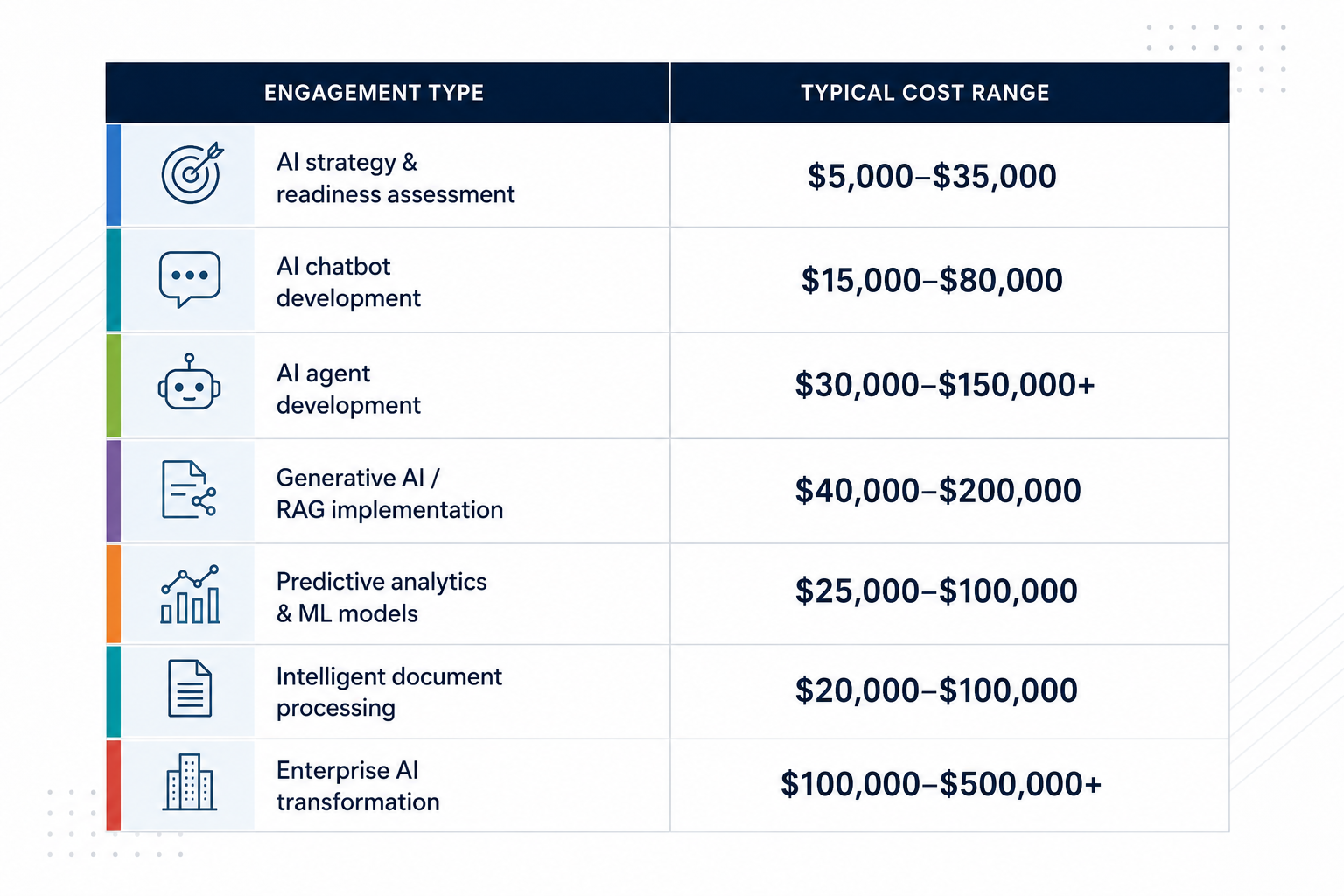
These are market ranges for US-based consulting firms in 2026. The sections below explain what moves your project toward the low or high end of each range.
AI Consulting Pricing Models: What You’ll Actually Pay
There’s no universal rate card for AI consulting. The price follows the shape of the engagement, and four shapes cover almost every quote you’ll see.
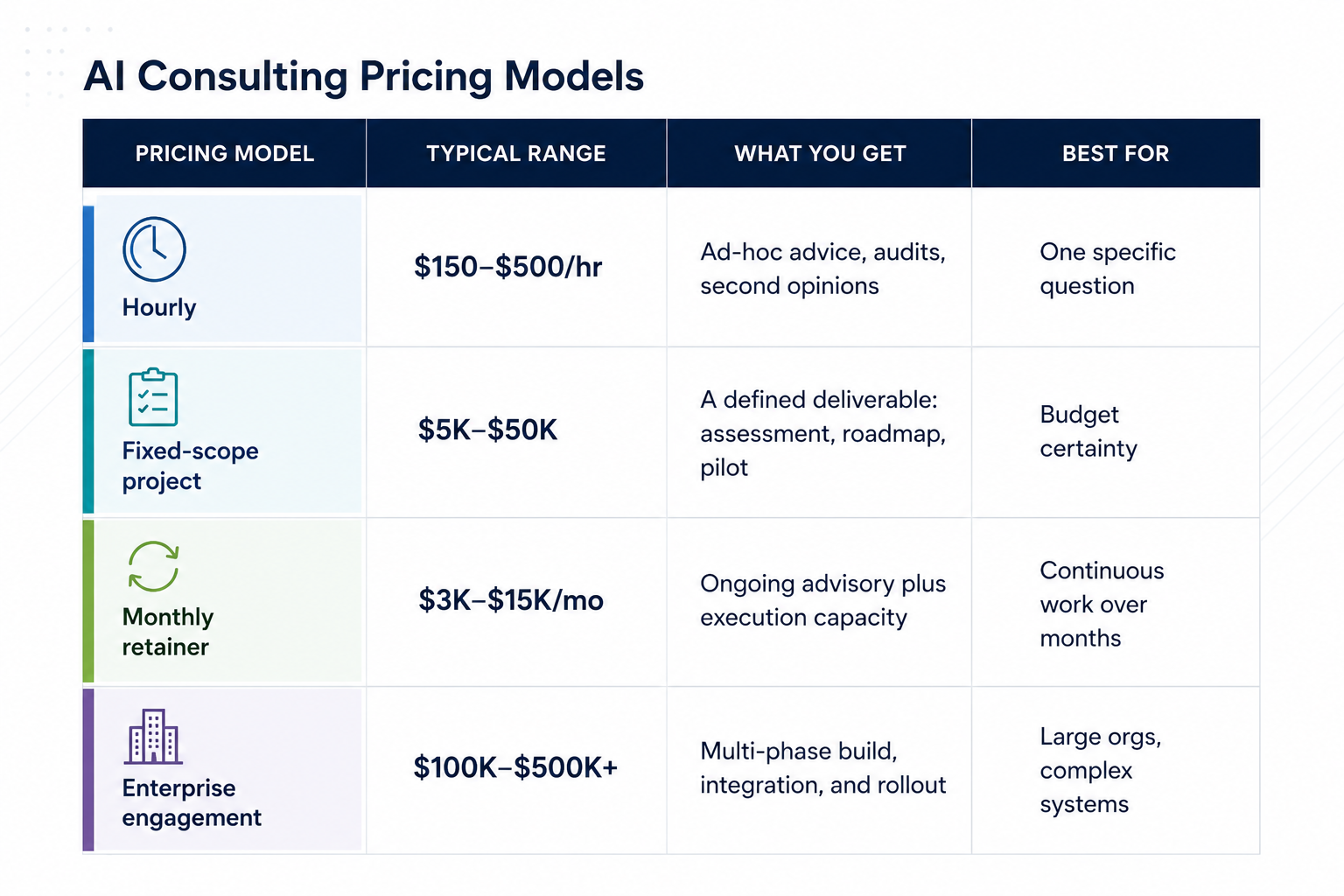
Within hourly work, experience sets the tier:
- Junior consultants ($100–$150/hr): defined, tactical tasks
- Mid-level consultants ($150–$300/hr): can carry both strategy and implementation
- Senior specialists ($300–$500+/hr): the people who have shipped agent architectures or fine-tuned models in production
Pure strategy work typically carries a 20–40% premium over implementation, because you’re paying for specialized judgment, not just coding hours.
The insight that matters more than any table: when two quotes for the “same” project are 10x apart, they’re almost never quoting the same work. One firm is pricing a roadmap document. The other is pricing working software. Before you compare numbers, make every vendor spell out exactly what gets delivered.
AI consultant hourly rates by region
If you’re evaluating consultants across geographies, rates vary significantly by market. These are typical 2026 market rates, not JanBask’s pricing:
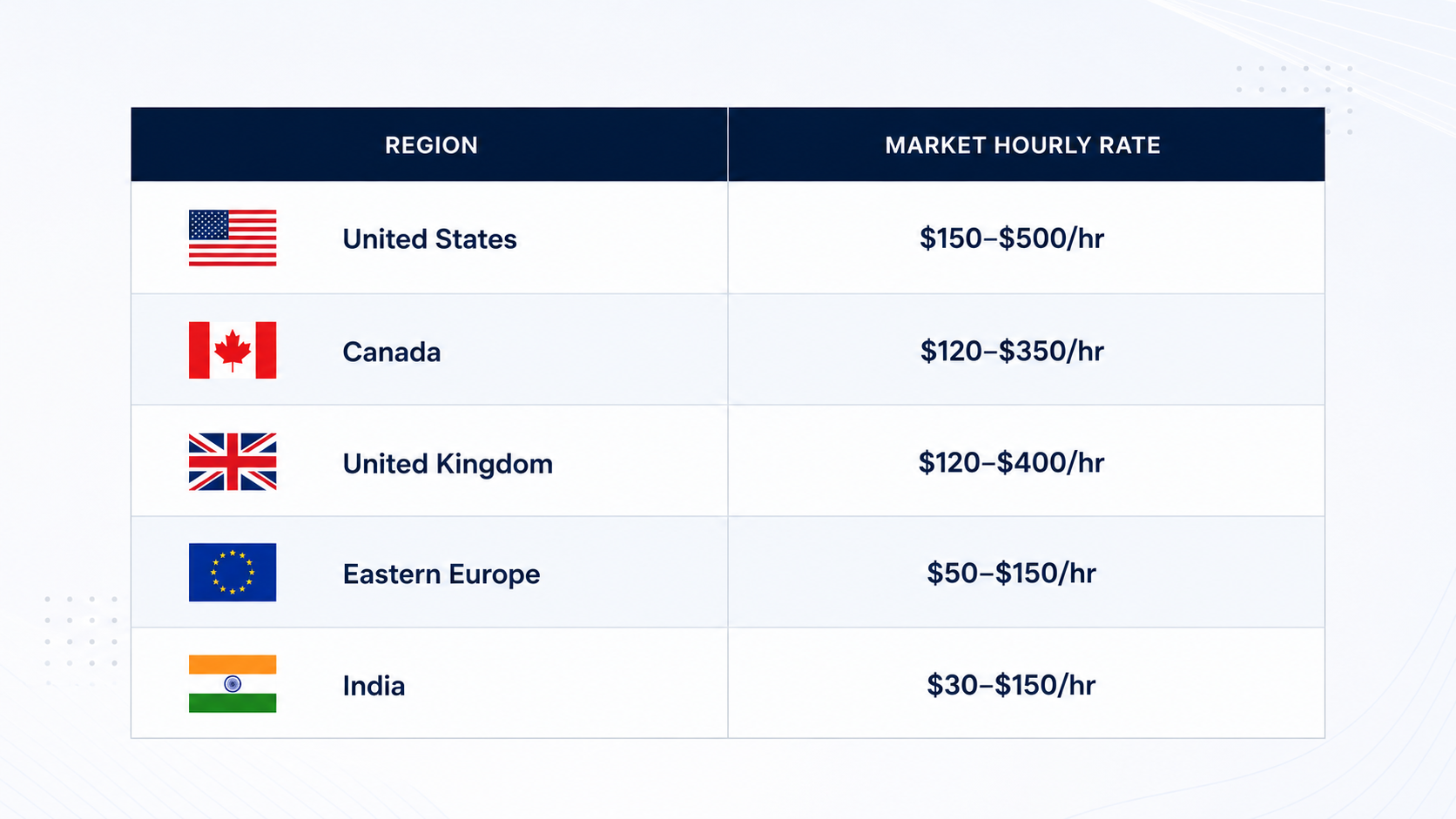
US-based firms typically reflect US rate ranges regardless of where delivery happens, because they carry the overhead of US client management, compliance alignment, and quality assurance. When evaluating an offshore quote, factor in the coordination cost and compliance risk, both real line items for regulated industries.
AI Consulting Cost by Business Size
The fastest way to ballpark your budget is to start with the size of your business, because engagement shape tends to follow company shape.
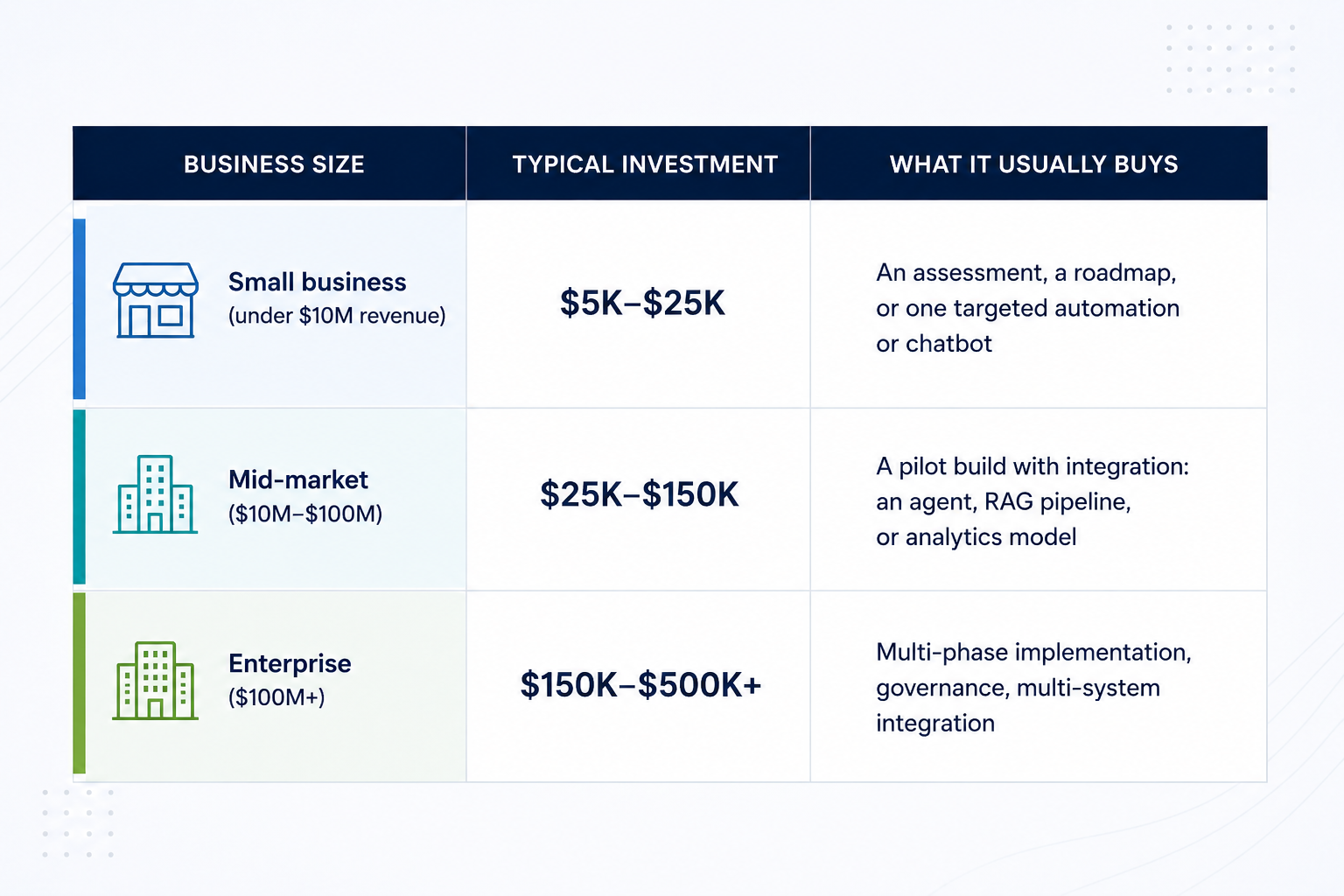
The most common buying mistake isn’t overpaying. It’s buying the wrong-shaped engagement for the size of the business. A $200K enterprise transformation program is built for a company with an internal data team and the patience for a multi-quarter rollout. Sold to a mid-market firm, that same program means paying for overhead and slowness designed for someone else.
The reverse is also true: an enterprise trying to solve a multi-system integration problem with a $15K assessment will get a nice document and no working software. Match the engagement to the business, not to the vendor’s preferred contract size.
AI Consulting Cost by Solution Type
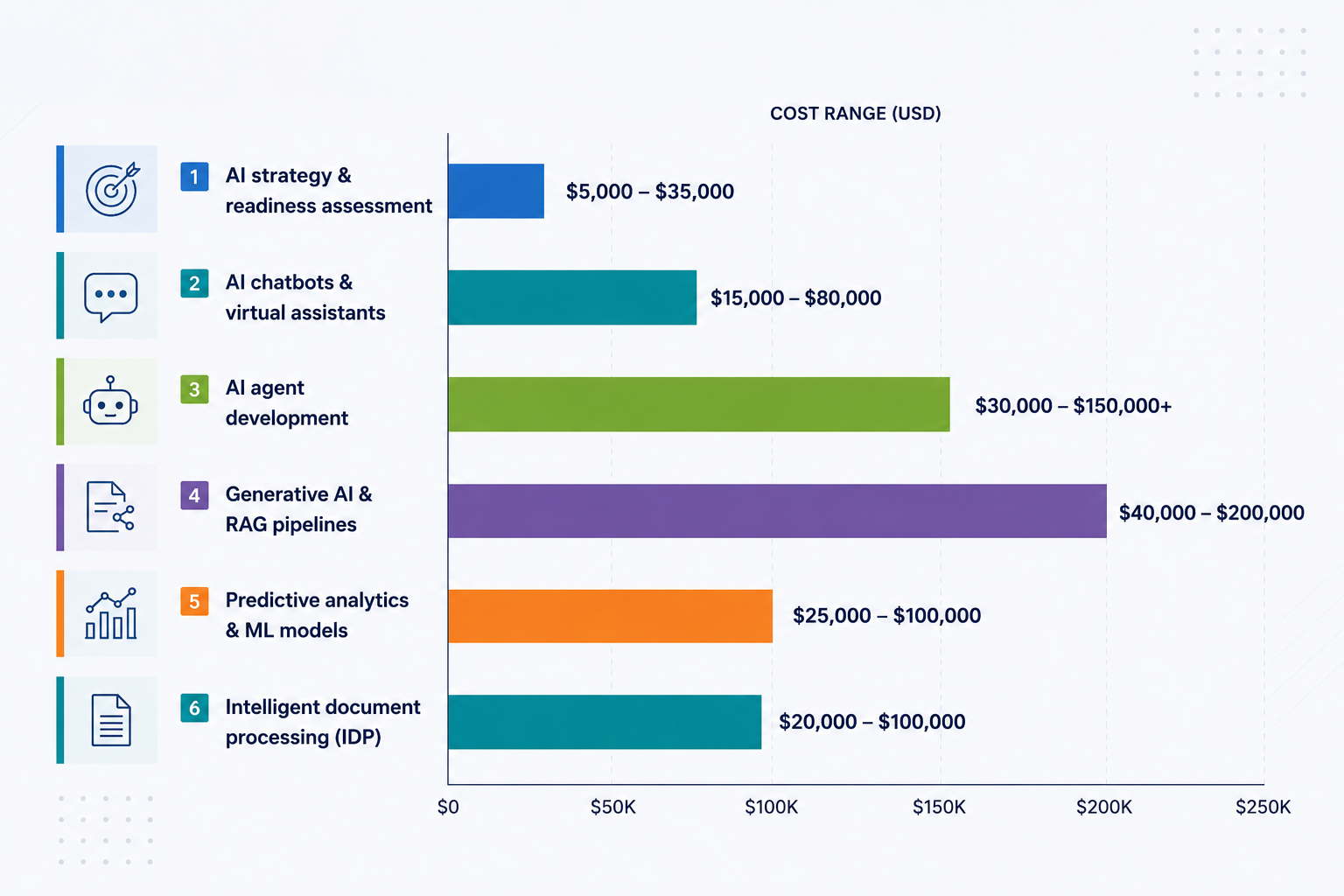
This is the breakdown most pricing guides skip, and it’s the one that actually predicts your quote. What you’re building moves the number far more than who you hire.
1. AI strategy & readiness assessment – $5,000-$35,000
A structured audit of your workflows, data, and systems that answers three questions: where AI is worth the money in your business, what to build first, and whether to build, buy, or fine-tune. It’s the cheapest item on this list and the one that de-risks everything below it. A good assessment is allowed to conclude that an off-the-shelf tool covers your need saving you a six-figure custom build.
2. AI chatbots & virtual assistants – $15,000-$80,000
A basic FAQ bot with a defined script sits at the low end. The price climbs with each capability you add: CRM integration, contextual memory across conversations, live-agent handoff, and deployment across web, WhatsApp, and mobile. An enterprise-grade assistant that pulls from your knowledge base and hands off cleanly to humans lands in the $50K–$80K range.
3. AI agent development – $30,000-$150,000+
Agents go beyond chatbots, software that plans and executes multi-step tasks across your systems instead of just answering questions. A single custom AI agent, say one that supports tickets, checks order systems, and drafts responses, starts around $30K. Enterprise AI agent pricing climbs with autonomy and reach: multi-agent setups with orchestration, governance, and human-in-the-loop controls regularly pass $200K. This is the highest-demand AI service category in 2026, and the one where scope definitions matter most.
4. Generative AI & RAG pipelines – $40,000-$200,000
Retrieval-augmented generation grounds a language model in your own documents and data, so answers come from your knowledge base instead of the open internet. A straightforward RAG build on clean data starts around $40K. The cost drivers are custom fine-tuning, private cloud deployment (AWS/Azure), and the messiness of your source data. AI copilots embedded in internal tools sit in the middle of this range.
5. Predictive analytics & ML models – $25,000-$100,000
Forecasting, churn prediction, fraud detection, and customer segmentation, models built on your historical data and connected to the BI stack you already use, whether that’s Tableau, Power BI, or Snowflake. Cost scales with data preparation effort and how many decisions the model feeds in real time.
6. Intelligent document processing (IDP) – $20,000-$100,000
Extraction, classification, and validation across contracts, invoices, and claims. A single document type with predictable formats sits at the low end. Compliance-ready processing for regulated industries, with audit trails and human review queues, sits at the top.
How Much Does AI Agent Development Cost?
AI agents deserve their own breakdown because the category is large and the pricing range is wide. Unlike chatbots, agents perform multi-step reasoning and take autonomous action across your systems, the complexity of what they do determines the cost more than any other factor.
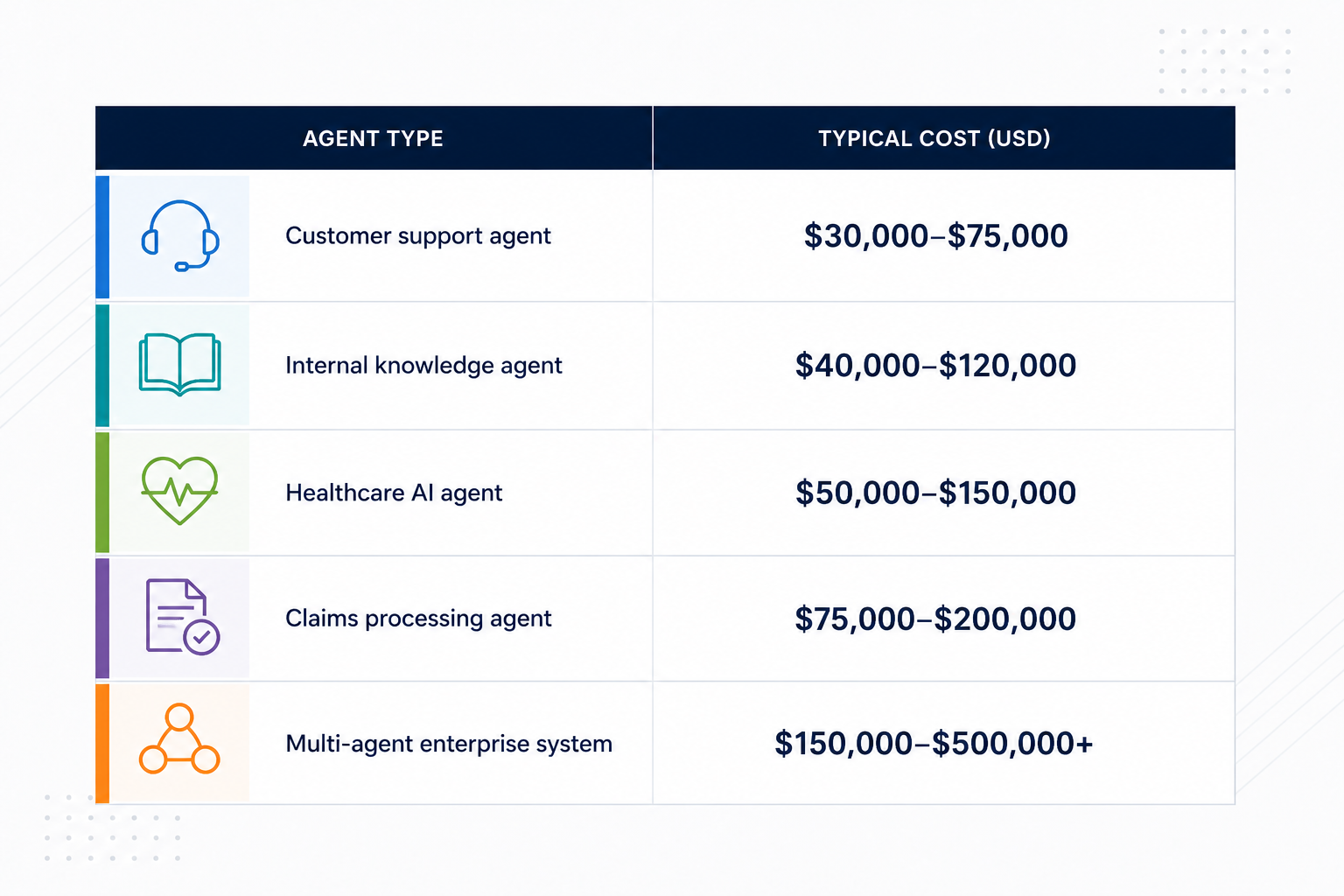
What drives the cost within each type: the number of systems the agent connects to, the level of autonomy it needs (can it act, or only recommend?), and whether the deployment environment requires compliance controls. A customer support agent that reads your knowledge base and drafts replies is far simpler than a healthcare agent that pulls from an EHR, applies clinical logic, and logs every decision for audit.
For healthcare and claims processing agents, the compliance premium covered in the industry section below applies on top of the base development cost.
The 5 Factors That Move the Number
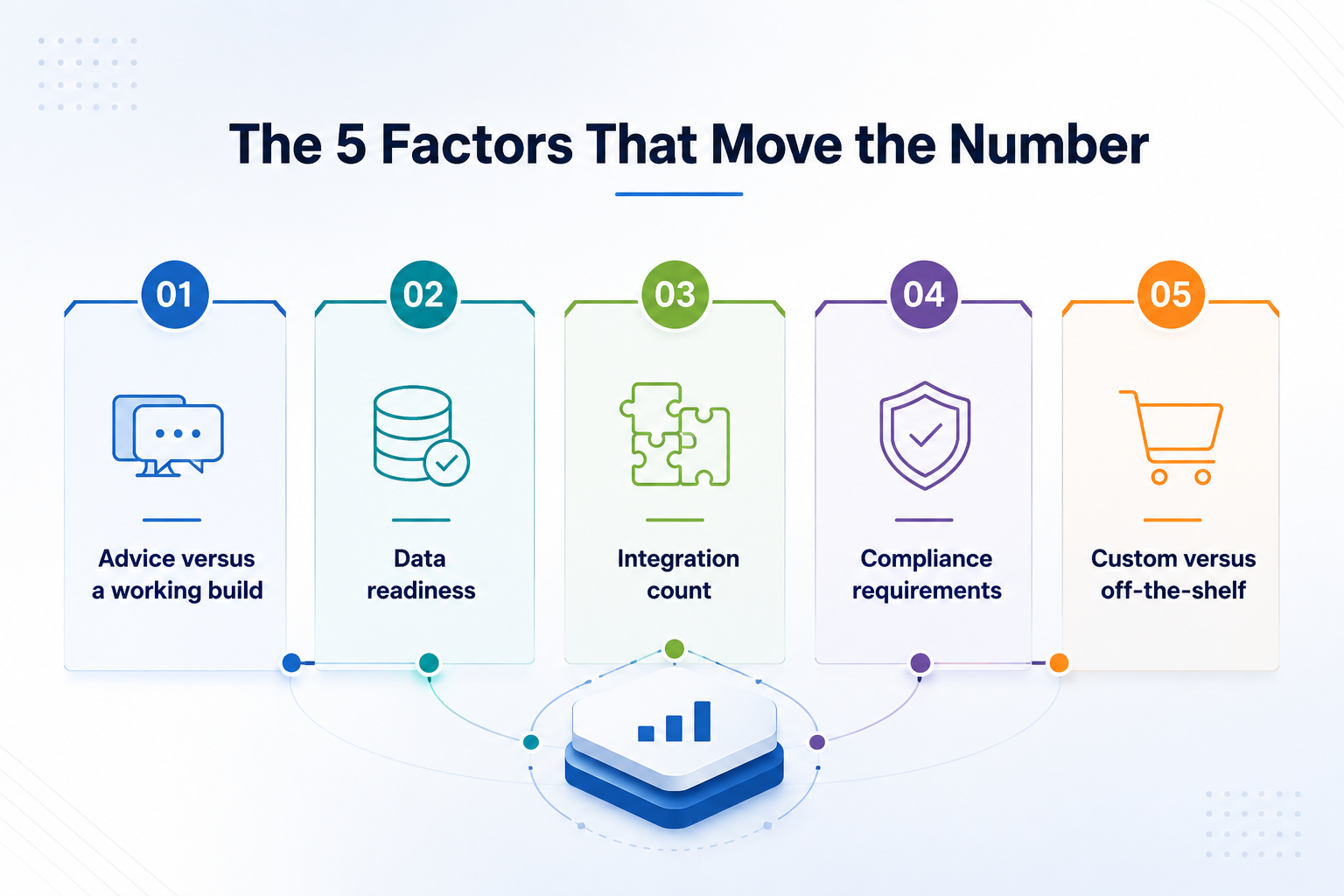 Two firms can quote the same project and land 10x apart. It’s rare because one of them is greedy. It’s almost always one of these five factors.
- Advice versus a working build. A roadmap costs a fraction of shipped software, because shipped software has to be written, QA-tested, integrated, and supported. A $40K quote for “strategy and recommendations” and a $40K quote for a working agent are different products at the same price. Know which one you’re buying.
- Data readiness. If your data is clean, labeled, and sitting in systems with APIs, the work moves fast. If it lives in spreadsheets, a legacy ERP, and three employees’ heads, a real chunk of the budget goes to data engineering before any AI touches it. This is the cost buyers never see coming, and the first thing an honest consultant will assess.
- Integration count. Wiring AI into one system is straightforward. Wiring it into your CRM, your ops database, your billing platform, and Slack, each with its own authentication, rate limits, and edge cases, is where the hours pile up. Ask every quote how many integrations it assumes.
- Compliance requirements. HIPAA, SOC 2, audit trails, model governance. If your industry is regulated, the foundational architecture changes and so does the price. More on this next.
- Custom versus off-the-shelf. Fine-tuned models and custom architecture cost more than configuring existing tools. Sometimes the honest answer is that an off-the-shelf product covers 90% of your need at 10% of the cost. A consultant who’s willing to talk you out of a custom build is one worth keeping.
AI Consulting Costs by Industry
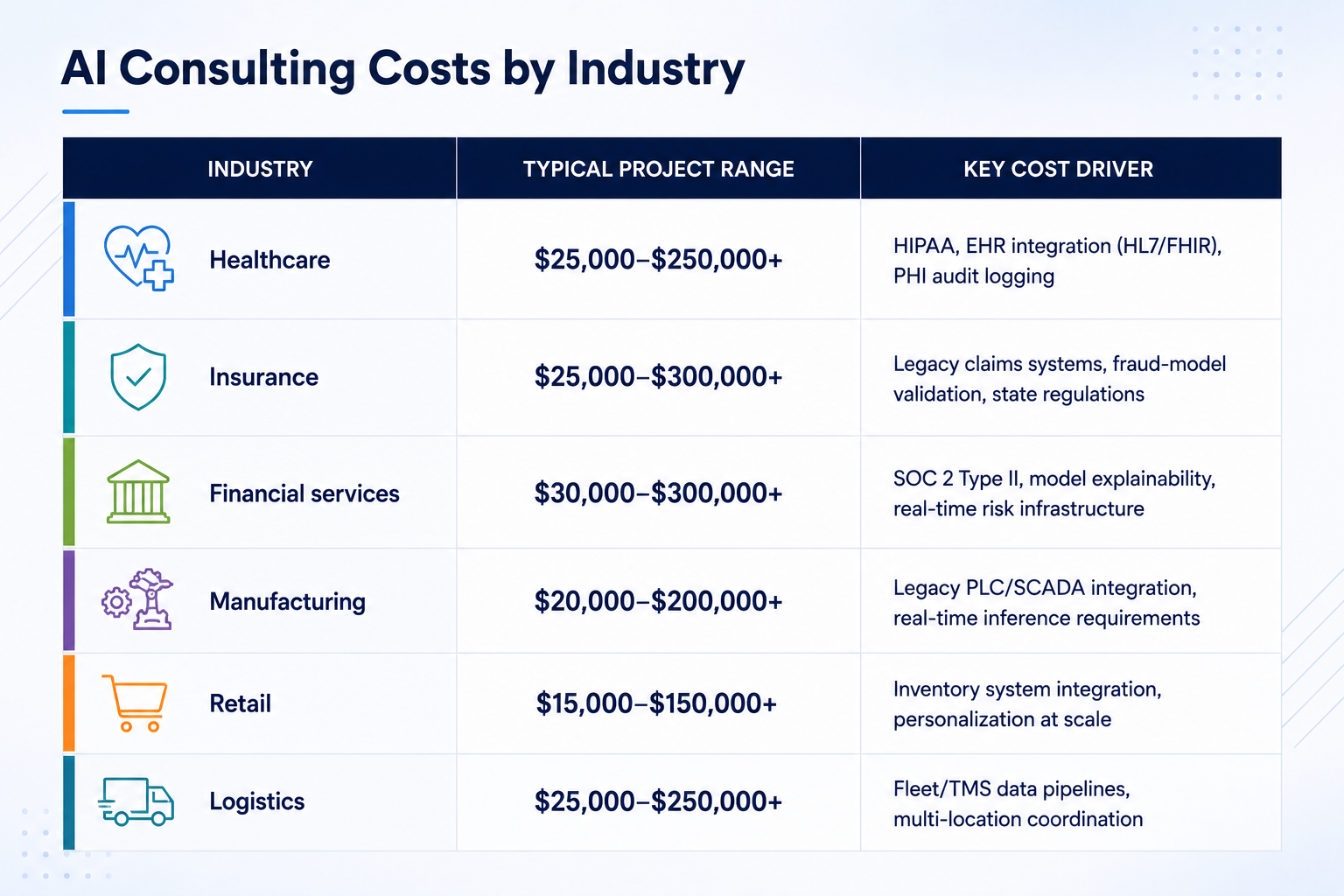
Domain expertise in regulated industries carries a real premium, typically 25–40% over the baseline ranges above. That’s not vendor markup. It’s the cost of engineering and audit work that an unregulated project never needs: compliant architecture, legal review, logging, and the documentation that keeps regulators satisfied.
Healthcare: expect a 25–40% premium
Healthcare AI implementation cost runs higher than any other vertical, and for concrete reasons: HIPAA-compliant infrastructure, business associate agreements (BAAs), EHR integration through HL7 and FHIR standards, protected health information handling, and audit logging on every data touch. A $60K patient-facing chatbot becomes an $80K+ build once it touches PHI, and that’s the version that doesn’t end in a fine. If a healthcare quote looks suspiciously cheap, compliance is usually what’s missing.
Insurance: expect a 20–35% premium
Insurance AI implementation cost is driven by claims-system integration, fraud-model validation, underwriting audit trails, and state-by-state regulatory requirements. Carriers and agencies also tend to run older core systems, which pushes integration hours up.
Financial services: expect a 20–35% premium
Financial services AI consulting cost reflects SOC 2 Type II requirements, model governance and explainability standards, and the infrastructure for real-time risk scoring. Regulators increasingly expect firms to explain exactly why a model made a decision and explainability is an engineering line item, not a checkbox.
Is AI Consulting Worth the Investment?
For most organizations that scope it correctly, yes, the returns justify the cost. McKinsey’s 2025 State of AI report found that function-level ROI is already real: software engineering, manufacturing, and IT organizations report 10–20% cost reductions tied to AI, while marketing and product development see revenue uplifts above 10%. That said, the same report found that only about 5.5% of organizations see measurable enterprise-level EBIT impact from AI, a gap that almost always traces back to organizational readiness, not the technology itself.
Understanding why most projects fail to show returns, and what the successful ones do differently, is a separate problem from pricing. For a deeper breakdown of the measurement gap and how to build a scorecard that actually captures AI value, see → Generative AI ROI: Why Most Enterprise Projects Look Like Failures on Paper
In claims processing and healthcare operations specifically, well-scoped AI implementations typically recover their cost within 12–18 months through reduced labor hours and error rates. The KPMG Insurance AI Adoption Study corroborates this timeline, and healthcare revenue cycle automation has shown similar payback windows across multiple industry analyses.
The caveat is “scoped correctly.” The projects that look like failures on paper are almost always ones where the scope was wrong for the budget, the data wasn’t ready, or the team never adopted the tool. A $150K implementation that sits unused returns zero. A $30K agent build that your operations team relies on daily returns multiples.
The cheapest form of ROI protection is buying clarity before you buy software: a $10K–$25K readiness assessment tells you whether a project will return anything before you commit six figures to building it.
AI Consulting Firm vs. Independent AI Consultant
When evaluating vendors, the choice often comes down to an independent consultant or a consulting firm. Here’s how they compare, and where each type fits best.
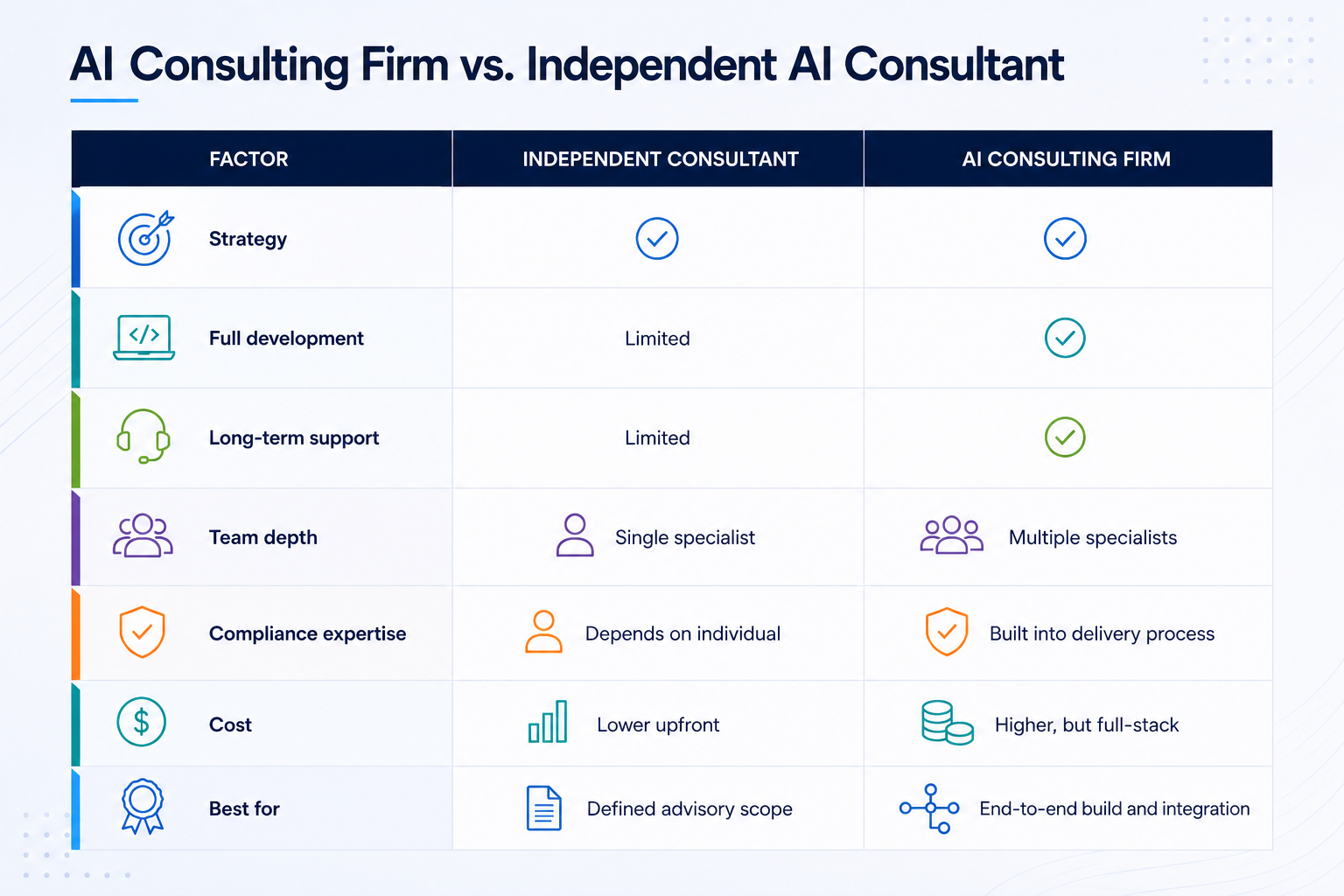
An independent consultant is a strong fit when you have an internal team that can take a strategy document and build from it. A consulting firm becomes the right choice when you need strategy, build, integration, compliance, and ongoing support from a single accountable partner.
The Hidden Costs No Quote Mentions
The consulting fee is the starting point, not the total. Most firms underestimate the total cost of ownership of an AI project by 30–50%, and the surprise usually arrives about six months after launch.
Here’s what a realistic first-year budget looks like for a $100K implementation:
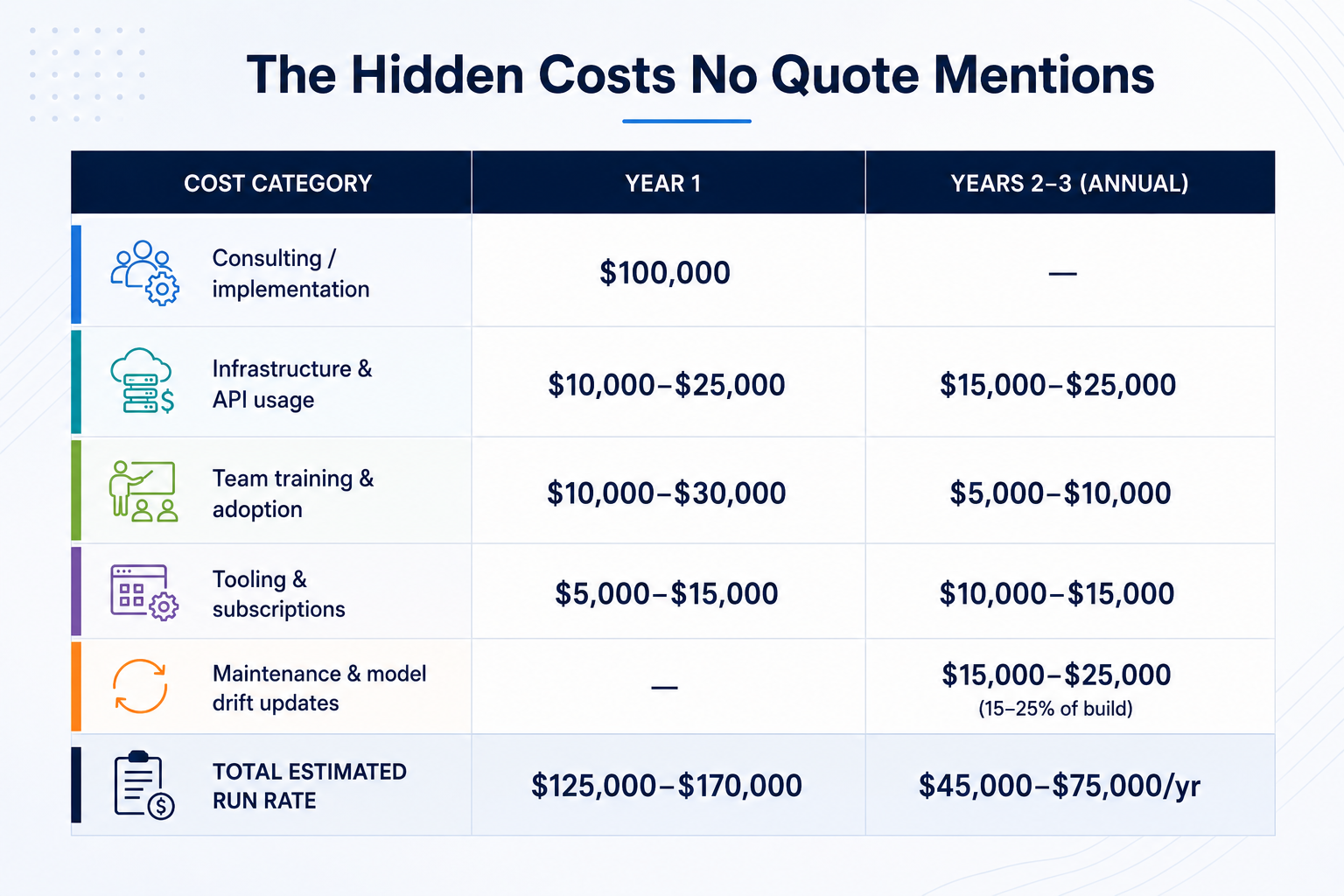
A few of these deserve a closer look. Maintenance isn’t optional: models drift as your business and data change, and a system nobody monitors and retrains quietly gets worse. API and infrastructure costs scale with usage. A successful AI tool costs more to run than a failed one, which is the one budget problem worth having. And training is what separates deployed AI from adopted AI software your team doesn’t use and returns exactly nothing.
None of this is a reason to skip the project. It’s a reason to budget the project honestly. A vendor who walks you through the total cost of ownership before you sign is showing you how they’ll behave after you sign.
How to Evaluate an AI Consulting Quote
You now know the ranges. Here’s how to pressure-test the specific quote in front of you.
Five questions to ask every vendor:
- What exactly is the final deliverable: a strategy document, a pilot, or a production-ready system?
- How many integrations does this quote assume, and what’s the change-order fee if we add one?
- What happens to the timeline and budget if our data isn’t as clean as we think it is?
- Who owns the IP the models, custom prompts, code, and weights when the engagement ends?
- What does post-deployment support cost, and what SLAs are guaranteed?
Four red flags that should slow you down:
- A large proposal submitted with no discovery or assessment phase first
- “AI transformation” language with no named workflows or systems
- No mention of maintenance, monitoring, or knowledge transfer anywhere in the proposal
- A price that doesn’t move when the scope does
A firm that answers the five questions directly and triggers none of the red flags is quoting in good faith — even if the number is higher than you hoped. A firm that dodges them is selling you a number, not a project.
Planning an AI Project? Get a Real Number First.
AI consulting in 2026 runs $150–$500 per hour, $5K–$50K for fixed-scope projects, and $100K–$500K+ for enterprise implementations, with your solution type, data readiness, integration count, and industry deciding where you land in those ranges. The quote is never the total, so budget for maintenance and infrastructure from day one.
And before you sign anything large, buy clarity first. A scoped assessment turns every number that follows into something you can judge instead of guess at, and it’s also the cheapest way to find out whether the project you’re pricing is even the right one to build.
If you’re at that stage now, JanBask’s AI consulting team can walk through your specific scope and give you a number you can actually plan around, not just a range.
Ready to accelerate your Artificial intelligence journey?
Talk to a JanBask specialist and get a strategy session tailored to your business.