



Maintaining meaningful, timely connections with supporters while staffing and budgeting is a constant challenge for nonprofit organizations.
Every donor question, missed volunteer inquiry, and delayed response eliminates an opportunity to build mission-critical relationships. Supporters expect immediate, personalized engagement, which traditional communication methods cannot meet.
New nonprofit AI chatbots change this. Twilio found that 58% of nonprofits use AI in digital communications, compared to 47% of commercial firms. This trend extends beyond the mere adoption of new technology. A large staff expansion allows an organization to connect with donors and volunteers in new ways.
Smart systems answer questions instantly, handle supporter interactions 24/7, and personalize conversations based on giving history and interests. AI chatbots can solve engagement issues that have slowed nonprofit growth and maximize mission impact.
Nonprofit AI agents free up human staff to focus on complex relationship building while answering every supporter inquiry, no matter when or how many people reach out.
To grasp the significance of AI chatbots for nonprofits, one must first be aware of the distinct operational limitations that these organizations encounter on a daily basis. Nonprofits face the challenge of meeting rising expectations for engagement and transparency with constrained resources, in contrast to for-profit businesses that can scale staffing levels in response to revenue growth. Nonprofits that feel overwhelmed by choosing the right tools can also rely on an AI consulting service to identify practical, budget-friendly chatbot solutions tailored to their needs.

The economic model in which for-profit businesses function is very different from that in which nonprofits function. Their reliance on revenue-driven business models, rather than grants, donations, and volunteer contributions, uniquely constrains their staffing and operational capacity.
Most nonprofits lack the staff to handle the constant questions from donors, volunteers, and others interested in the organization’s programs. According to conventional staffing models, emails pertaining to tax deductions sent at 9 p.m. or requests for details regarding forthcoming events made by volunteers on Sunday afternoons go unanswered until the following business day.
The repercussions go beyond just being inconvenient. Funding challenges and resource constraints are major factors in the demise of approximately 30% of nonprofit organizations within a decade, according to research. With an average yearly growth rate of 1.4% over the previous 20 years, the number of nonprofits has increased, making donor attention more competitive.
No matter when they contact, modern supporters expect instantaneous, tailored responses. Donors want to know the ins and outs of the donation process, the opportunities to volunteer, and the results of the programs before committing their time or money.
Especially during high-volume times like end-of-year fundraising campaigns or crisis response scenarios, manual communication methods struggle to keep up with these expectations.
Instead of concentrating on building strategic relationships and doing mission-critical work that genuinely demands human expertise and emotional intelligence, staff members end up spending hours answering repetitive questions.
The capacity of an organization to fund and carry out its mission is directly impacted by the opportunities that are missed due to the disparity between what supporters expect and what the organization can actually provide. With each passing second, there is a greater chance that a donor will go elsewhere or that a volunteer will opt not to participate.
Nonprofits with limited resources can now build and maintain donor relationships with AI chatbots. Digital assistants handle donor communication while staff focus on building strategic relationships with supporters.
Donor questions and AI chatbots don’t follow office hours. Tokyo supporters can ask about matching gift programs at 3 AM Eastern Time and get a quick, accurate response. At 11 PM in California, someone researching end-of-year giving can get basic donation information without waiting until the next business day.
This constant availability is important because potential donors research organizations in the evenings or on weekends when they can donate. Chatbots turn interest into action rather than unanswered questions.
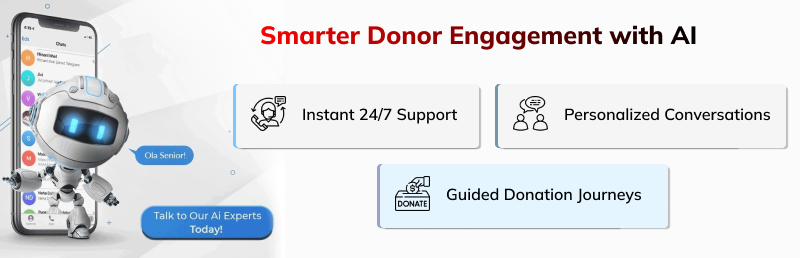
AI chatbots use donor databases to personalize every interaction. When a returning donor starts a conversation, the chatbot remembers their contributions and responds accordingly. Former donors receive program updates and opportunities.
This personalization goes beyond name recognition. Chatbots can recommend donation amounts based on past giving patterns, share impact reports about programs a donor has supported, and suggest new initiatives that match their interests.
Friction during the donation process, not lack of interest, leads to the loss of many donations. AI chatbots instantly guide supporters and address their concerns.
The AI chatbot instantly answers questions about tax deductibility. The chatbot can verify employer eligibility and explain matching gift programs to donors. The chatbot promptly responds to inquiries regarding payment methods, recurring donations, and memorial gifts.
More donors want to see their donations’ results. AI chatbots can provide real-time fundraising campaign updates, program beneficiary stories, and donation usage details.
When donors ask, “How is my contribution making a difference?” the chatbot can pull impact data, share success stories, and link their gift to measurable outcomes. Transparency fosters trust and loyalty.
Lapsed donors are a valuable but underutilized segment for many nonprofits. AI chatbots can identify inactive donors and start natural re-engagement conversations.
These interactions may update donors on programs they supported, highlight new initiatives that match their interests, or check if their priorities have changed. The chatbot can scale initial outreach and identify lapsed donors who want staff follow-up.
Many nonprofits rely on volunteers, but coordinating their efforts takes time and attention. AI chatbots for nonprofits automate coordination tasks and provide volunteers with support and information to contribute effectively.
Before contributing, new volunteers need clear instructions on an organization’s mission, roles, and procedures. Virtual onboarding guides volunteers through essential steps at their own pace with AI chatbots.
Digital assistants can provide training materials, answer volunteer obligation questions, and help newcomers understand safety and certification requirements. Volunteers can complete onboarding whenever they want, reducing participation barriers.
Organizational complexity can overwhelm small staff teams when scheduling volunteers for multiple events and programs. AI chatbots automate this process, assisting volunteers in finding and signing up for shifts that align with their availability and interests.
The chatbot displays opportunities, confirms registrations instantly, and sends automated confirmations. After volunteers reschedule, the chatbot notifies others of new slots, maintaining schedule continuity without staff intervention.
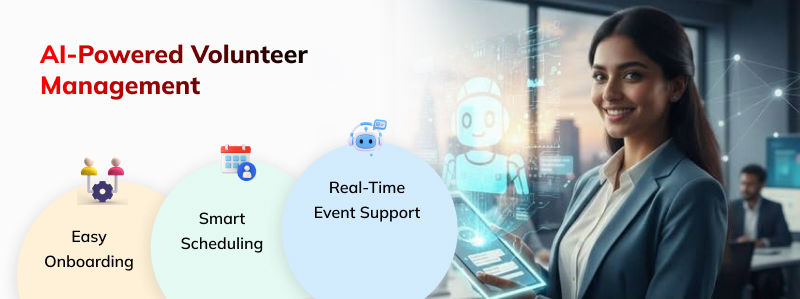
No-show Volunteers disrupt programs and last-minute coordination. AI chatbots help volunteers by reminding them of upcoming shifts via their preferred channels. These reminders may include the event, location, and what to bring.
Research shows that automated reminders reduce no-show rates by reaching volunteers when they need the information. Volunteers can confirm attendance or cancel if plans change with follow-up messages from the chatbot, giving staff time to find replacements.
Volunteer questions about logistics, supplies, duties, and unexpected situations are common at large events and community programs. AI chatbots provide volunteers with real-time resources on their phones.
Instead of reaching out to a staff coordinator, volunteers can inquire about the location of supplies or instructions from the chatbot. While answering routine questions, the chatbot can escalate complex issues to supervisors for human judgment.
Crisis response, major fundraising campaigns, and seasonal programs often require rapid volunteer mobilization that goes beyond traditional coordination. During surges, AI chatbots process many volunteer applications, answer questions, and coordinate schedules.
Chatbots can match volunteer skills with urgent needs, communicate safety information, and coordinate deployment during natural disasters without overwhelming staff who must focus on strategic response coordination.
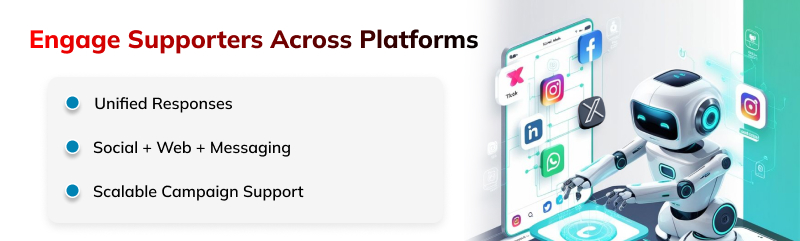
Websites, social media, messaging apps, and email are where supporters interact with nonprofits today. AI chatbots keep supporters engaged across all channels without requiring staff to monitor each platform.
Every nonprofit receives repeated questions about donation processes, program details, volunteer opportunities, and organizational impact. These inquiries come from website forms, social media comments, email, and direct messages.
Supporters can contact the organization via Facebook Messenger, WhatsApp, or the website, and AI chatbots answer these common questions accurately. Consistency builds credibility and eliminates staff answering the same questions across platforms.
Interaction with supporters during fundraising campaigns can overwhelm small teams. AI chatbots answer campaign-specific questions on social media and direct supporters to donation opportunities to manage this surge.
Mercy Corps’ chatbot fundraising campaigns increased online donations by 30% in the first month, according to research. The chatbot could handle thousands of conversations at once, taking care of potential donors during peak campaign periods.
Nonprofits must communicate safety information, coordinate volunteer deployment, and update affected communities during emergencies and disasters. The speed and volume of these communications often exceed staff capacity.
People affected by Hurricane Florence received real-time updates and assistance from the American Red Cross Florence Bot. AI agents for nonprofits can manage crisis communication at scales impossible for human teams, as the chatbot handled over 20,000 inquiries in the first week.
Understanding supporter preferences improves nonprofit programs and communication. AI chatbots can survey supporters after donations, volunteer shifts, or program participation while memories are fresh.
The chatbots identify patterns and concerns in responses, giving organizations actionable insights into what’s working and what’s not. Due to their ease of use and engagement, conversational email surveys get higher response rates than traditional ones.
Keeping supporters informed about organizational progress and impact fosters long-term engagement. Through personalized messages on multiple platforms, AI chatbots can share success stories, program updates, and milestone achievements.
Instead of waiting for monthly newsletters, supporters can ask the chatbot for program updates and get current information. Having impact data on demand helps donors feel more connected to their contributions.
Personalization strengthens donor relationships and volunteer engagement, but most nonprofits lack the resources to individually address thousands of supporters. Artificial intelligence chatbots automate personalization using supporter data and interaction history to solve this paradox.
AI chatbots track interaction with an organization to identify preferences, interests, and communication patterns. Since people frequently ask about environmental programs or donate during specific campaigns, the chatbot adjusts its interactions accordingly.
Continuous learning occurs without control. Each conversation gives the chatbot new data on what supporters value and how they prefer to receive it.
The AI chatbot can use previous donations, volunteer shifts, and interests to contextualize conversations with returning supporters. Funders of youth education programs receive updates on student outcomes and new initiatives, not just organizational news.
The American Cancer Society used machine learning to study which digital advertising campaigns resonated with different donor segments, allowing them to tailor outreach to individual giving patterns and preferences.
Relationships and first impressions matter. AI chatbots can introduce returning visitors by name, acknowledge their contributions, and resume conversations. Recognition makes supporters feel valued, not like anonymous website visitors.
Organizations using Qualified reports find that identifying high-value donors on the website and sending personalized greetings boosts engagement and donation conversion.
Volunteers and donors want to know if their contributions matter. AI chatbots can link donations to program outcomes, share stories about beneficiaries, and provide personalized impact reports that show where supporters’ money went.
This detailed acknowledgement boosts organizational success and emotional investment. If supporters can see how their work made a difference, they’re more likely to keep giving.
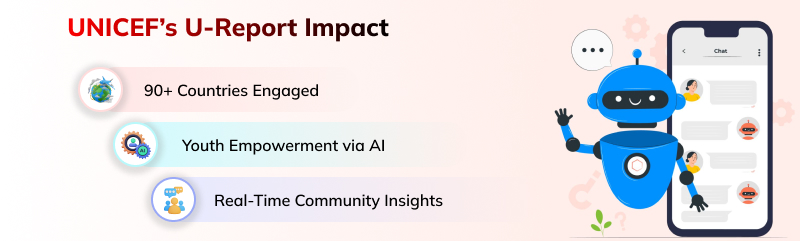
The most convincing evidence of AI chatbot effectiveness comes from large-scale users. UNICEF’s U-Report platform shows how AI chatbots can engage millions of supporters about important social issues.
Through WhatsApp, Facebook Messenger, and SMS chatbots, U-Report reaches millions of young people in over 90 countries. The platform provides resources and community perspectives on climate action and mental health issues.
Due to COVID-19, U-Report provided life-saving health information to young people without access to traditional media. The Mental Health Chatbot helps youth manage stress, while the Climate ActBot teaches environmental advocacy.
U-Report’s two-way communication works well. Polls, stories, and community opinions from young people inform UNICEF’s program development. This approach turns supporters into doers.
It shows how AI for nonprofit fundraising and engagement goes beyond automation to create unprecedented participation.
AI chatbots are a practical solution for nonprofits that are struggling to meet supporter expectations while operating on limited resources. These tools increase organizational capacity without increasing budgets by providing 24/7 access, personalizing interactions on a large scale, and automating routine tasks.
The technology handles routine inquiries and administrative tasks, allowing employees to focus on strategic relationship building and mission-critical work that requires human judgment. Organizations considering AI implementation require partners who understand both technology and non-profit operational realities. JanBask specializes in AI solutions and digital transformation, assisting organizations to leverage these technologies while maintaining genuine human connections.
As AI adoption grows in the nonprofit sector, early adopters gain a competitive advantage in donor retention, volunteer engagement, and operational efficiency, all of which translate directly into increased mission impact.
Stop, read and acquire deep insights into complex issues
© 2025 Copyright - JanBask.com | Designed by - JanBask Digital Design



Write a Comment